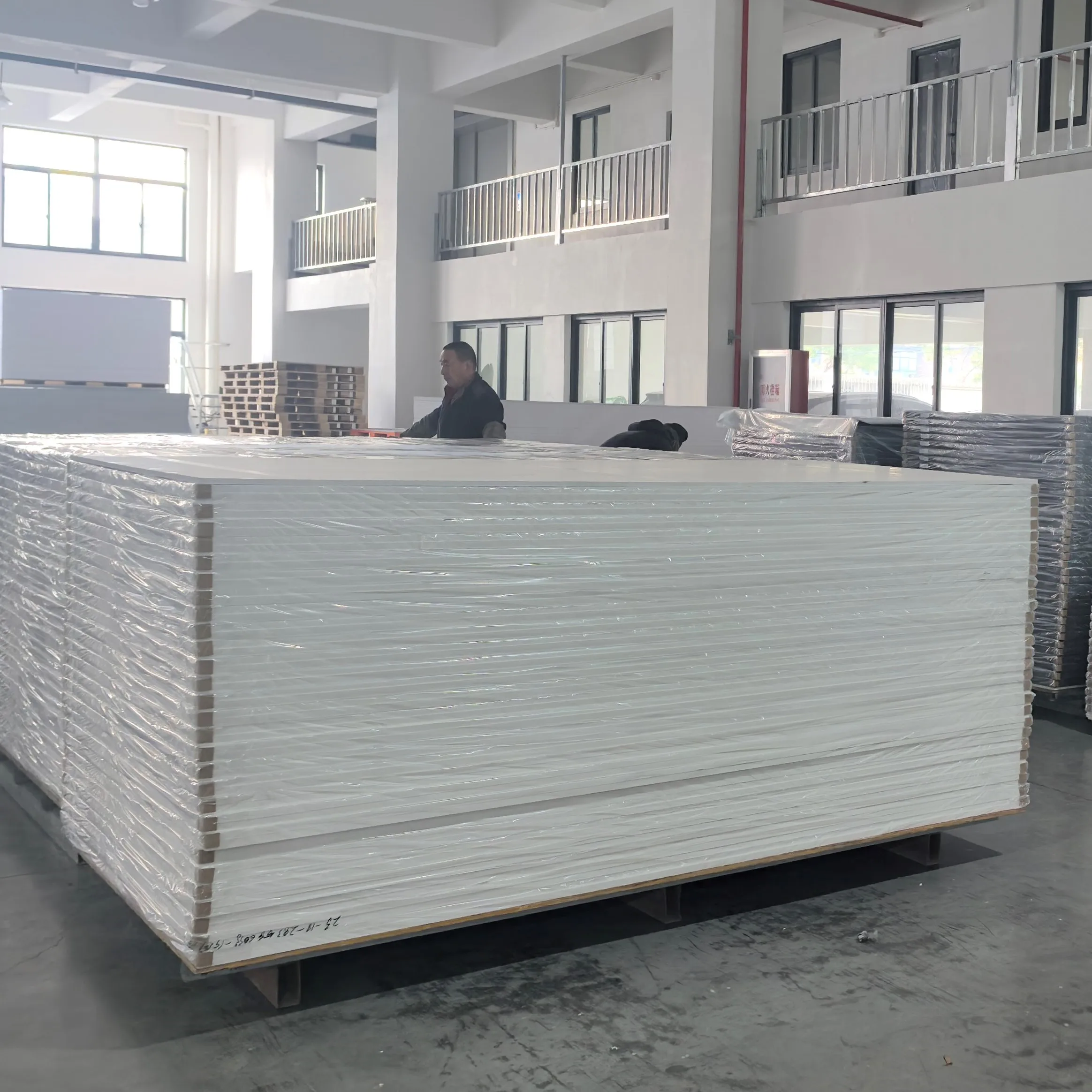

A TDS — technical data sheet — is the document that decides whether you get what you ordered. Yet most buyers read the price column of a quotation and skip the datasheet entirely, then discover six weeks later that the delivered board is 0.48 g/cm³ when the project needed 0.6, or that a "18 mm" board measures 17.4 mm.
This guide explains the six numbers that actually matter on a PVC foam board TDS, what industry-normal values look like, and how to write a purchase specification short enough to paste into a PI but specific enough to be enforceable.
Why the datasheet matters more than the quote
Two quotations for "18 mm white PVC foam board" can differ by 30% in price and still both be technically accurate — because the two boards are not the same product. The difference lives in numbers the quotation does not show:
|
What the quote says |
What it does not say |
|
"18 mm" |
Thickness tolerance — ±0.2 mm or ±0.5 mm? |
|
"PVC foam board" |
Density, and density tolerance |
|
"White" |
Core colour, and colour consistency between batches |
|
"High strength" |
Flexural strength, screw withdrawal |
|
"CE / RoHS" |
Which report, which edition, still valid? |
|
BUYER WARNING If a supplier cannot provide a TDS, treat that absence as a material sourcing signal. |
The datasheet answers these. If a supplier cannot or will not provide one, that is itself the answer.

Figure 1. Comparing a technical data sheet with the physical board sample.
1. Density — nominal vs measured
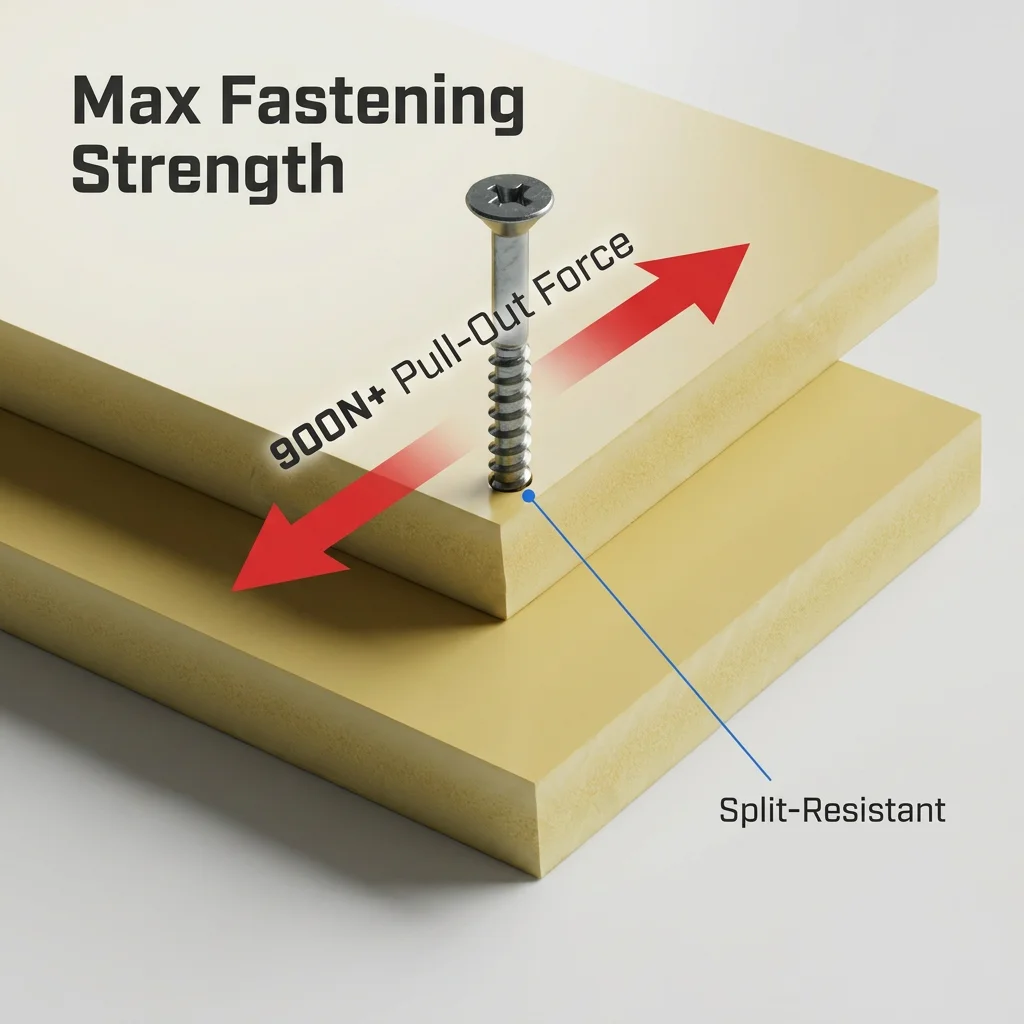
Density is the single most important number on the sheet. It controls stiffness, impact resistance, screw-holding and how the board behaves under load — and it is the most common source of specification shortfall.
What "nominal" means. A board sold as 0.55 g/cm³ is not exactly 0.55 everywhere. The figure is a target, and the tolerance around it is what you need to confirm. A density tolerance of ±0.02 g/cm³ is a useful industry reference; ±0.05 or unspecified is not.
How to verify it yourself. Cut a precise 20 cm × 20 cm piece, measure thickness with a caliper, and weigh it. For a 12 mm board at 0.55 g/cm³, the calculation is:
Volume = 20 × 20 × 1.2 cm = 480 cm³
Expected weight = 480 × 0.55 = 264 g
Weigh the sample. A reading far below 264 g means the density is below specification. This takes five minutes and settles the question.
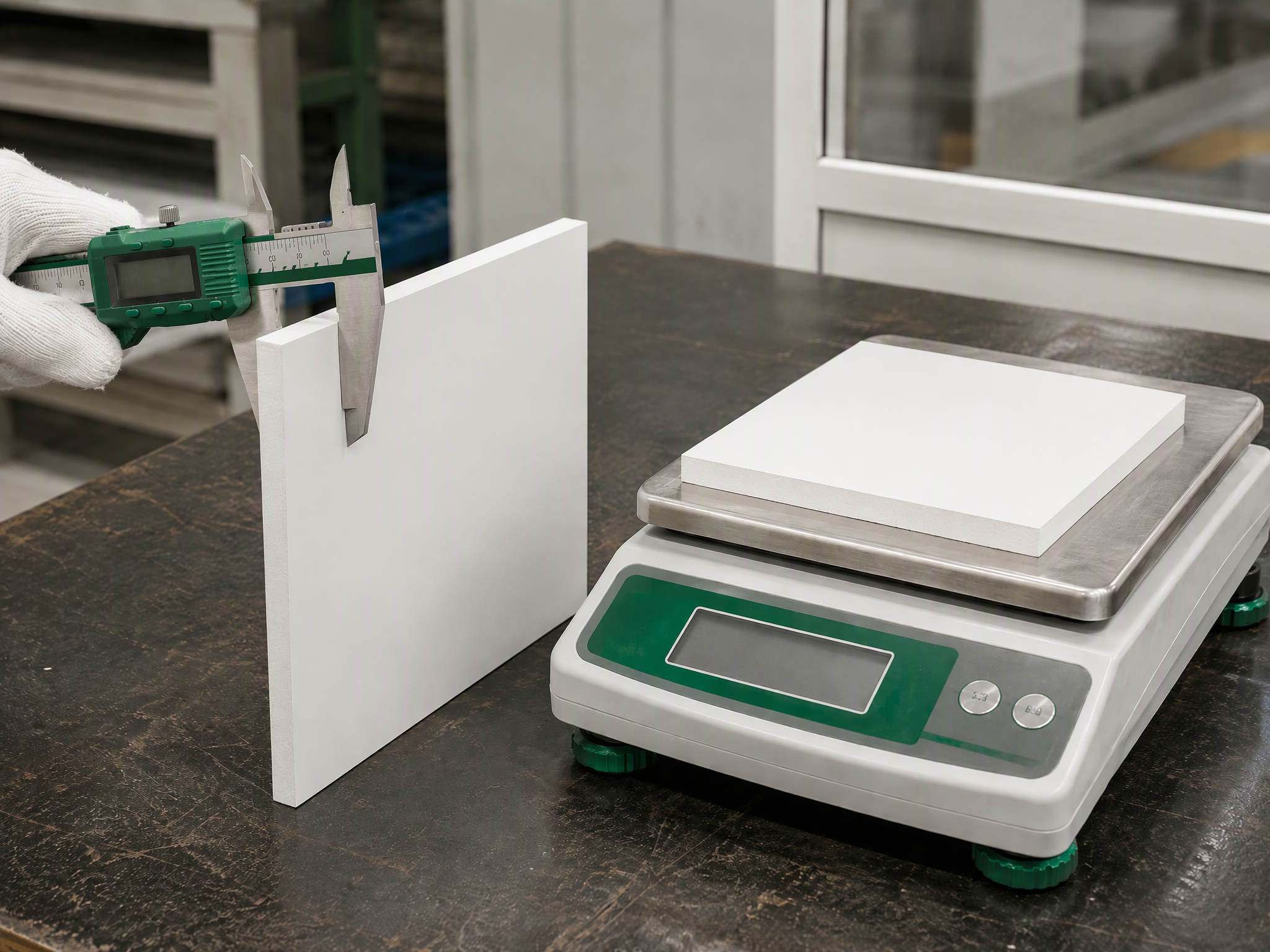
Figure 2. A practical density check: measure the sample, then weigh it.
Density bands and what they are for:
|
Density |
Suitable applications |
|
0.3 – 0.35 g/cm³ |
Advertising displays, screen printing, CNC engraving |
|
0.4 – 0.5 g/cm³ |
Indoor decorative panels, non-load-bearing partitions |
|
0.5 – 0.7 g/cm³ |
Cabinet carcasses, doors, wall substrates, hardware-mounting areas |
|
0.7 – 1.0 g/cm³ |
Load-bearing cabinets, countertop substrates, machined parts |
2. Thickness tolerance
This is where specification shortfall is most often hidden, because thickness is the number everyone thinks they have already agreed.
Industry reference values for PVC foam board — these are typical industry figures, not a universal standard:
|
Thickness range |
Typical tolerance |
|
1 – 5 mm |
±0.2 mm |
|
5 – 10 mm |
±0.2 mm |
|
10 – 20 mm |
±0.3 mm |
|
20 – 30 mm |
±0.3 mm |
On an 18 mm board, ±0.3 mm is roughly 1.7% — normally invisible in a single sheet, but meaningful across a full container when the board forms a visible panel thickness or sits inside a machined groove.
The right question is not "what is your tolerance" but "is it in the PI". A tolerance that appears only in an email is not a specification; it is a conversation.
3. Flatness, diagonal and length/width
|
Parameter |
Typical industry reference |
|
Length / width |
±5 mm |
|
Diagonal |
≤ 10 mm |
|
Flatness |
≤ 2 mm per metre |
Flatness deserves attention if the board will be laminated, printed or used as a door panel — a bow that is invisible on the pallet can show up as an uneven gap in the finished product. Note also that warping is often not a manufacturing defect at all: it frequently arises from prolonged vertical storage or from container temperature swings in transit. Storing boards flat on a level pallet and allowing 24–72 hours of recovery usually resolves it.
4. Mechanical properties worth asking for
Density tells you what the board is. Mechanical data tells you what it can do. These are the values to request:
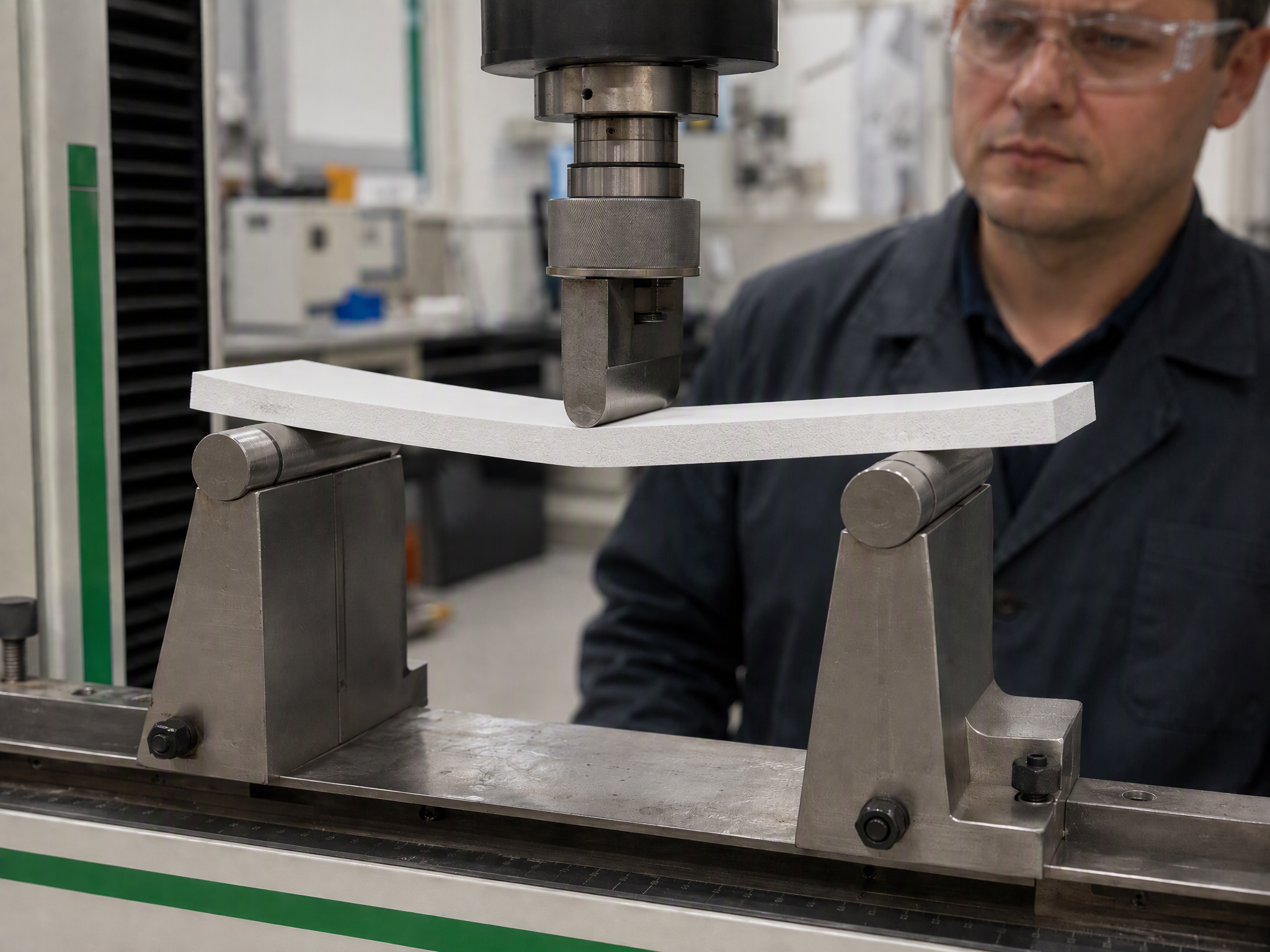
Figure 3. Three-point flexural testing of a PVC foam board specimen.
|
Property |
Why it matters |
|
Flexural strength |
Predicts shelf, span and panel behaviour |
|
Flexural modulus |
Stiffness — how much it deflects under load |
|
Screw withdrawal |
Whether hardware will hold |
|
Vicat softening point |
The upper limit for sustained heat exposure |
|
Thermal conductivity |
Relevant for insulation and cold-climate applications |
Our verified figures, from SGS test reports:
|
Property |
Result |
Standard |
|
Flexural strength |
14.9 MPa |
ASTM D790 |
|
Flexural modulus |
1,420 MPa |
ASTM D790 |
|
Screw withdrawal |
PASS |
EN 320:2011 |
|
Vicat softening point |
56 °C |
Measured, report available |
|
Thermal conductivity |
0.0678 W/(m·K) |
SGS |
|
Heat capacity |
0.907 J/(g·K) |
SGS |
For context on the limits: these boards are suitable for cabinet carcasses and shelves within reasonable spans, furniture structural parts with hardware, and countertop substrates. They are not recommended for building structural members such as beams, columns or slabs, for sustained loading at high temperature (PVC creep), or for long unsupported shelf spans — we suggest spans of 800 mm or less, depending on thickness and load.
5. Environmental and compliance data
Where the project has an indoor-air-quality or market-access requirement, the datasheet must carry the actual test result, not a claim. The numbers to look for:
|
Item |
Value to look for |
|
Formaldehyde emission |
Our boards: ND (Not Detected, below 0.080 mg/m³), against a GB 18580-2017 E1 limit of 0.124 mg/m³ |
|
RoHS |
Our boards: all 10 restricted substances PASS |
|
REACH-SVHC |
Our boards: 253 candidate substances PASS |
|
GHS classification |
Our MSDS shows no GHS hazard classification |
|
Fire |
Report number, edition year and classification (see our separate guide on fire ratings) |
One thing worth knowing about honest datasheets. Not every property has been tested, and a credible supplier will say so rather than leave a blank or an estimate. In our own documentation we state openly that thermal expansion coefficient and heat deflection temperature (HDT) are not yet tested, that our flatness tolerance has no published standard, and that we do not hold EN 71-3 or CPSIA / CPC reports. You should be more concerned by a datasheet with a suspiciously complete set of figures than by one that marks its gaps.
6. The seven-line purchase specification
|
COPY-READY A concise seven-line specification for your purchase order or PI. |
Copy this into your purchase order or PI. It is short enough to be practical and specific enough to be enforceable.
1. Product / process: PVC foam board, Celuka integral skin (or co-extrusion / free foam)
2. Density: 0.55 g/cm³, tolerance ±0.02 g/cm³
3. Thickness: 18 mm, tolerance ±0.3 mm
4. Sheet size: 1220 × 2440 mm, tolerance ±5 mm
5. Flatness: ≤ 2 mm per metre
6. Colour: White, core colour to match surface; sample approved on ______
7. Certification: TDS and test reports required with shipment: ISO 9001, CE EN 14041,
RoHS, REACH-SVHC, formaldehyde, fire report
Add two clauses and the specification becomes genuinely protective:
Inspection: "Density and thickness to be verified by the buyer on receipt; non-conforming material to be resolved by replacement or price adjustment."
Batch consistency: "Colour to be matched against the approved sample retained by the supplier."
7. Questions to ask before you sign
Will the density and thickness tolerance be written into the PI or contract?
Can you provide an outgoing inspection record for this batch?
How is an out-of-tolerance result handled — replacement, credit or price adjustment?
Are the certification reports you cite current, and what is their expiry date?
Which properties on your datasheet are measured and which are industry references?
Question five is the one most buyers never ask, and it is the one that separates a specification from a marketing document.
Frequently asked questions
What is a normal thickness tolerance for PVC foam board?
Industry reference values are ±0.2 mm for 1–10 mm board and ±0.3 mm for 10–30 mm board. These are typical industry figures rather than a universal standard, so confirm the value that applies to your order and have it written into the PI.
How can I check density without a laboratory?
Cut a precise 20 cm × 20 cm sample, measure its thickness with a caliper, weigh it, and divide weight by volume. Compare the result with the nominal figure on the TDS. It is accurate enough to identify a specification shortfall.
What mechanical data should I request?
Flexural strength, flexural modulus and screw withdrawal as a minimum, plus Vicat softening point and thermal conductivity if the application involves heat or insulation. Ask which standard each value was tested to.
Does a supplier have to disclose untested properties?
There is no rule requiring it, which is exactly why you should ask. A datasheet that marks its gaps is more reliable than one that reports a complete set of figures without test references.
Can Pluswin provide a TDS and test reports before I order?
Yes. TDS v4.1 (English) and SDS (English) are available, along with all 13 active certifications — ISO 9001, CE EN 14041, RoHS 2026, REACH-SVHC 2026, ECE R118, ASTM E84, formaldehyde E1, physical property reports and composition analysis. Reports are sent on request, no NDA required, and certificate numbers are verifiable directly with SGS, Intertek and FEMKO.
Request the documentation
Send us the application and the thickness you are considering, and we will return the TDS, the relevant test reports and a recommended specification — including which tolerances we can commit to in writing.
Hangzhou Jiaying Trade Co., Ltd. (Pluswin) — ISO 9001:2015 certified (certificate 29324Q118491R0S) · 13 active certifications from SGS, Intertek and FEMKO · manufacturer since 2006.