

PVC Foam Board Glossary Celuka, Forex, Foamex, Sintra, Andy Board and More
|
The short answer The trade name on an enquiry is not a technical specification. Whether a buyer asks for Celuka, Forex, Foamex, Sintra, Andy Board, Chevron Board or Sunboard, every rigid PVC foam sheet is manufactured by one of three extrusion processes (Free Foam, Celuka / Integral Skin, or Co-Extrusion) at a specific density (0.30 to 1.0 g/cm³) and thickness (1 to 30 mm). Ordering by the 5-line technical specification prevents costly container mismatches. |
Ask five international suppliers for “PVC foam board” — or send an RFQ naming “Forex,” “Foamex,” “Sintra,” or “Andy Board” — and you may receive five quotations for five completely different materials. One factory quotes a 0.32 g/cm³ free-foam signage sheet; another quotes a 0.60 g/cm³ integral-skin cabinet board. Both suppliers believe they answered your enquiry accurately.
This glossary maps every major trade name, process term and regional nickname in global circulation to the actual extrusion process, density range and application it represents — so your purchasing team can translate any customer request into an unambiguous factory specification.
1. Why One Material Family Has Over Fifteen Names
Rigid expanded PVC sheet is a generic thermoplastic material family, not a single branded product. The terms buyers encounter in technical drawings, tenders and distributor catalogues come from four distinct sources:
- Extrusion process names — terms that originally described the tooling and foaming method (such as Celuka or Free Foam) and later became shorthand for the board itself.
- Third-party manufacturer trademarks — proprietary brand names (such as Forex, Sintra, KömaCel, Komatex or Palight) that became genericized everyday nouns in certain regional signage or construction markets.
- Export and regional trade nicknames — terms born in specific domestic or export trade channels, such as Andy Board (安迪板) and Chevron Board (雪弗板) in China export trade, Foamex in the UK and Ireland, or Sunboard in South Asia.
- Surface or composite descriptors — terms that describe how the board is finished or reinforced, such as PVC Crust Board, Laminated PVC Board, or WPC (Wood-Plastic Composite) Foam Board.
|
What the trade name never tells you Nominal density (g/cm³), thickness tolerance (mm), surface hardness and screw-holding force — the exact physical variables that determine whether the sheet works in UV printing, CNC engraving or kitchen cabinetry. |
2. The Three Extrusion Processes Behind Every Trade Name
Regardless of what a distributor calls the sheet, every pure PVC foam board is produced on one of three extrusion lines. Understanding these three cross-sections is the key to decoding the entire glossary.
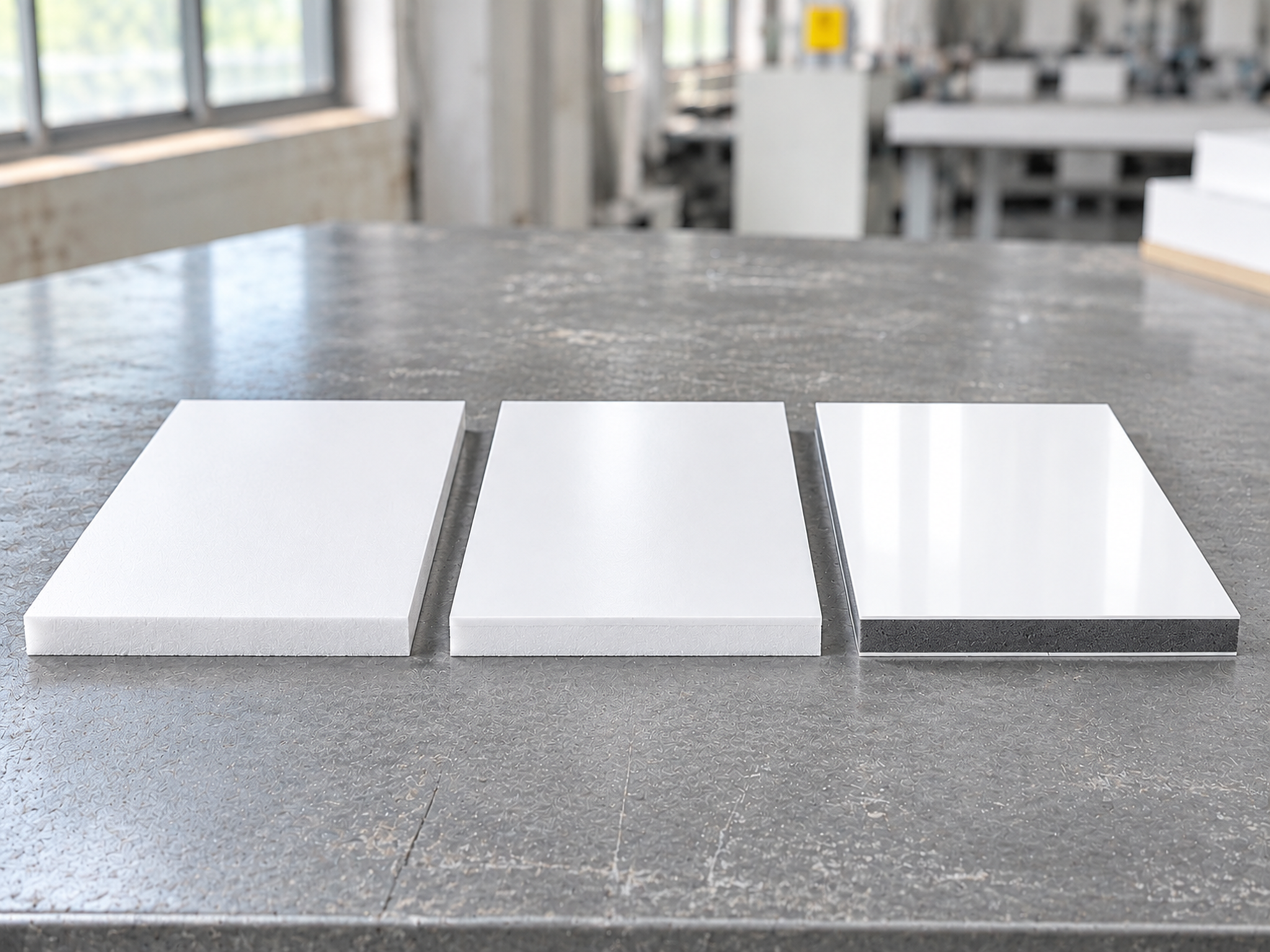
Figure 1. Physical 18 mm cross-section comparison on a factory inspection bench: Free Foam (left, uniform matte white micro-cellular structure), Celuka Integral-Skin (centre, smooth dense white skin over a fine white foam core), and Co-Extrusion (right, smooth high-hardness glossy white top and bottom outer layers bonded to a dark charcoal fine micro-foam core).
2.1 Free Foam (Open-Die / Standard Expanded PVC — Pluswin Series PL-08)
The foaming PVC melt expands freely as it exits the die before passing through calibration rollers, without forming a compressed outer crust. The result is a uniform, fine closed-cell micro-foam with a matte surface and no hard skin. Standard density is 0.30–0.35 g/cm³ in thicknesses from 1 to 20 mm. Best suited for flat UV digital printing, screen printing, exhibition graphics and light CNC lettering. It does not hold hinges, screws or V-grooves reliably.
2.2 Celuka / Integral-Skin Foam (Crust Board — Pluswin Series PL-01)
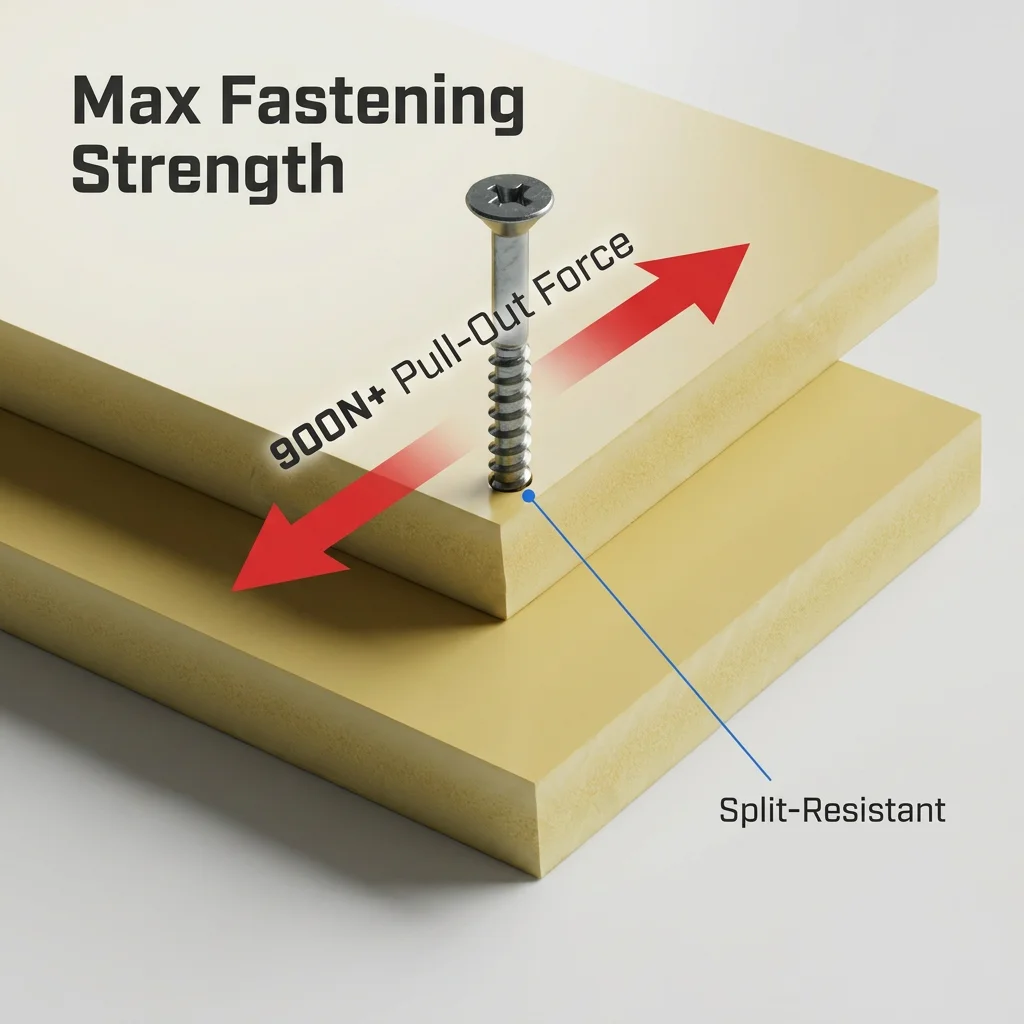
Developed from the inward-foaming cooled-die process, a calibrated cooling die chills the outer surfaces immediately as the extrudate leaves the die while the interior foams inward. This forms a smooth, dense, hard outer skin encapsulating a fine closed-cell core of the same formulation. Standard density covers 0.40–1.0 g/cm³ in thicknesses from 1 to 30 mm. Ideal for kitchen and bathroom vanities, furniture carcasses, CNC grooving, screw fixing (≥ 850 N under EN 320:2011 at cabinet densities) and thermoforming (100–140 °C).
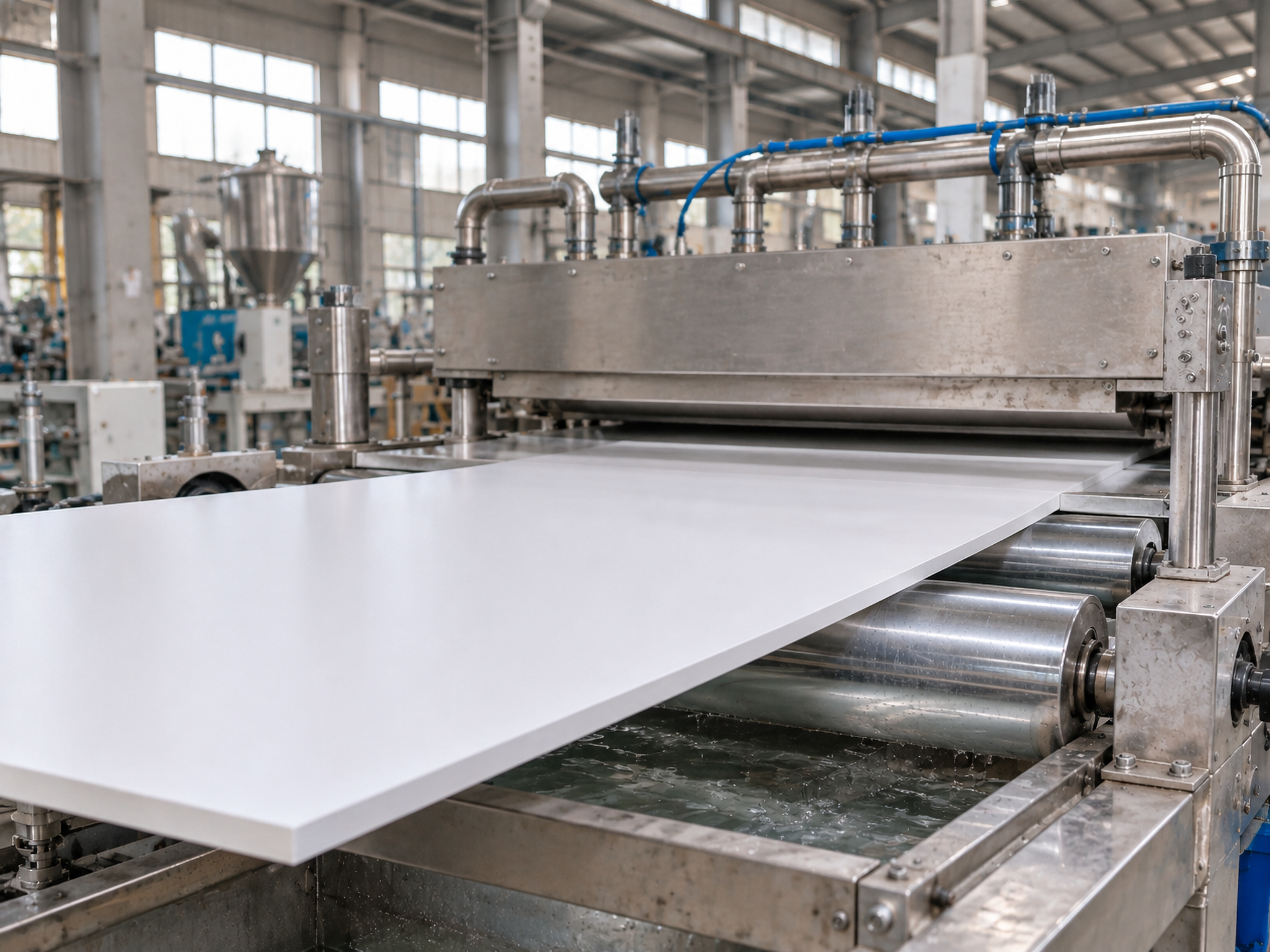
Figure 2. A continuous white PVC Celuka foam board sheet passing through stainless steel vacuum calibration and cooling rollers in the extrusion workshop.
2.3 Co-Extrusion PVC Foam Board (ABA Multi-Layer — Pluswin Series PL-04)
Two extruders feed one multi-manifold die simultaneously, fusing a dedicated high-hardness outer surface layer directly onto a foamed PVC core. Because the surface and core have separate formulations, the outer layer can be optimised for scratch resistance, hardness and weatherability independently of the core. Standard density covers 0.50–0.85 g/cm³ in thicknesses from 3 to 30 mm, available in 3 core colours (white, black, yellow) plus 9 surface colours.
|
Property |
Free Foam (PL-08) |
Celuka / Integral Skin (PL-01) |
Co-Extrusion (PL-04) |
WPC Foam Board (PL-03) |
|
Typical Density |
0.30–0.35 g/cm³ |
0.40–1.0 g/cm³ |
0.50–0.85 g/cm³ |
0.50–0.70 g/cm³ |
|
Typical Thickness |
1–20 mm |
1–30 mm |
3–30 mm |
5–30 mm |
|
Outer Surface |
Matte, no dense skin |
Smooth integral dense skin |
Dedicated rigid co-extruded layer |
Dense skin with wood/bamboo fibre |
|
Screw & Hinge Holding |
Not recommended |
Good to Excellent (0.55–0.75 g/cm³) |
Excellent (highest surface hardness) |
Excellent (reinforced by plant fibre) |
|
Colour Options |
Primarily white |
Same colour through skin and core |
3 core + 9 surface colours |
Natural wood-tone / white substrate |
|
Primary Applications |
Signage, UV printing, displays |
Cabinets, vanities, millwork |
Heavy-duty furniture, two-tone engraving |
Cabinetry, door frames, wall panels |
3. A-to-Z Glossary of PVC Foam Board Trade Names
|
Term / Trade Name |
Origin / Category |
What Buyers Usually Mean |
Pluswin Equivalent & Specification Advice |
|
Andy Board (安迪板) |
China export & signage nickname |
Phonetic transliteration used in export trade for expanded PVC sheet, especially 1–10 mm signage boards |
Usually maps to Free Foam (PL-08, 0.30–0.35 g/cm³) for printing, though sometimes used loosely for thin Celuka (PL-01). Always confirm density and skin. |
|
Celuka Board |
Extrusion process name |
Integral-skin PVC foam board with a smooth, hard outer crust and foamed core |
Pluswin PL-01 Celuka PVC Foam Board (1–30 mm, 0.40–1.0 g/cm³). Always specify nominal density (e.g. 0.55 g/cm³). |
|
Chevron Board (雪弗板) |
China domestic & export trade name |
Used interchangeably with Andy Board for white rigid PVC foam sheets in CNC lettering and displays |
Confirm whether the end use is flat signage (PL-08 Free Foam) or structural cabinetry/engraving (PL-01 Celuka). |
|
Co-Extruded PVC Board |
Extrusion process name (ABA) |
Multi-layer PVC foam board with a dedicated hard surface layer over a foamed core |
Pluswin PL-04 Co-Extrusion Board (3–30 mm, 0.50–0.85 g/cm³), 3 core + 9 surface colours. |
|
Crust Board / Skin Foam |
Descriptive process term |
Direct translation of integral-skin board with a dense surface crust |
Pluswin PL-01 Celuka PVC Foam Board. |
|
Expanded PVC (EPVC) |
Generic material term |
Closed-cell foamed rigid PVC sheet (distinct from solid rigid PVC sheet) |
Covers all foamed PVC lines (PL-08, PL-01, PL-04). Require thickness and density to quote. |
|
Foamex |
Regional trade name (UK & Ireland) |
Used by UK sign makers and exhibition contractors for 3 mm, 5 mm and 10 mm PVC foam sheet |
Quote Free Foam (PL-08) for flat printing or mid-density Celuka (PL-01, 0.45–0.50 g/cm³) for smoother skin. |
|
Forex |
Registered brand of 3A Composites |
Frequently used in European enquiries as shorthand for rigid white PVC foam board |
Check whether the buyer needs a lightweight print substrate (0.35–0.45 g/cm³) or structural sheet (0.50–0.70 g/cm³). |
|
Free Foam PVC |
Extrusion process name |
Open-die expanded PVC foam sheet with a uniform matte surface and no dense outer crust |
Pluswin PL-08 Free Foam Board (1–20 mm, 0.30–0.35 g/cm³). |
|
KömaCel |
Registered brand of Kömmerling |
Integral skin-foam PVC-U sheet with a hard, smooth outer skin |
Maps by process to Celuka (PL-01) or Co-Extrusion (PL-04) at 0.55–0.75 g/cm³. |
|
Komatex |
Registered brand of Kömmerling |
Fine-textured matte-surface free-foam PVC sheet for printing and signage |
Maps by process to Free Foam (PL-08). |
|
Laminated PVC Board |
Surface-finished product term |
PVC or WPC foam substrate factory-laminated with decorative PVC, PET or wood-grain film |
Pluswin PL-02 Laminated Board (PUR hot-melt lamination workshop + PL-07 edge banding). |
|
Palight |
Registered brand of Palram |
Foamed PVC sheet family used across signage, printing and fabrication |
Confirm whether free-foam or integral-skin surface is required, then match thickness and density. |
|
Sintra |
Registered brand of 3A Composites |
Widely used in North America by sign shops and exhibit builders for expanded PVC sheet |
Clarify thickness (mm), colour and density (g/cm³) to match router or flatbed printer setup. |
|
Sunboard |
Regional trade name (South Asia / ME) |
Rigid white PVC foam sheet used for vinyl mounting, POS displays and indoor signage |
Typically maps to Free Foam (PL-08) or light Celuka (PL-01) in 2–8 mm thicknesses. |
|
WPC Foam Board |
Composite material name |
Wood-Plastic Composite foam board blending PVC resin, calcium filler and wood/bamboo fibre |
Pluswin PL-03 WPC Foam Board (5–30 mm, 0.50–0.70 g/cm³) for cabinetry, door frames and wall panels. |
Trademark disclaimer: Third-party brand names above (including Forex, Sintra, KömaCel, Komatex, Palight and others) are the property of their respective owners and are referenced strictly for editorial and technical identification. Hangzhou Jiaying Trade Co., Ltd. (Pluswin) is not affiliated with, endorsed by, or manufacturing under these third-party brands.
4. Why Density Decodes the Trade Name
Two suppliers can both quote “18 mm Celuka PVC Foam Board” — or “18 mm Andy Board” — at prices that differ by 35%. Neither is necessarily overcharging; they are quoting different densities. Because PVC foam board is sold per sheet while raw material cost scales by weight, density (g/cm³) locks both mechanical performance and container loading math:
|
Density Band |
Pluswin Product Line |
Mechanical Behaviour |
Recommended Applications |
|
0.30–0.35 g/cm³ |
PL-08 Free Foam |
Lowest weight, most economical per sheet, easy cutting; low screw retention |
UV digital printing, screen printing, exhibition graphics, temporary displays, CNC lettering |
|
0.40–0.50 g/cm³ |
PL-01 Celuka (Mid Range) |
Smooth hard skin with light core; good flatness, moderate rigidity |
Indoor decorative wall panels, ceiling linings, non-load-bearing partitions, display racks |
|
0.50–0.70 g/cm³ |
PL-01 Celuka (High) / PL-03 WPC / PL-04 Co-Extrusion |
Optimal strength-to-weight balance; passes EN 320:2011 screw holding (≥ 850 N) |
Kitchen & bathroom cabinet carcasses, vanity doors, furniture components, hardware-mounting zones |
|
0.70–1.00 g/cm³ |
PL-01 Celuka (Extra-High) / PL-04 Co-Extrusion |
Highest surface hardness and load capacity; heavier sheet weight and faster tool wear |
Heavy-duty structural cabinetry, countertop substrates, industrial machined parts |
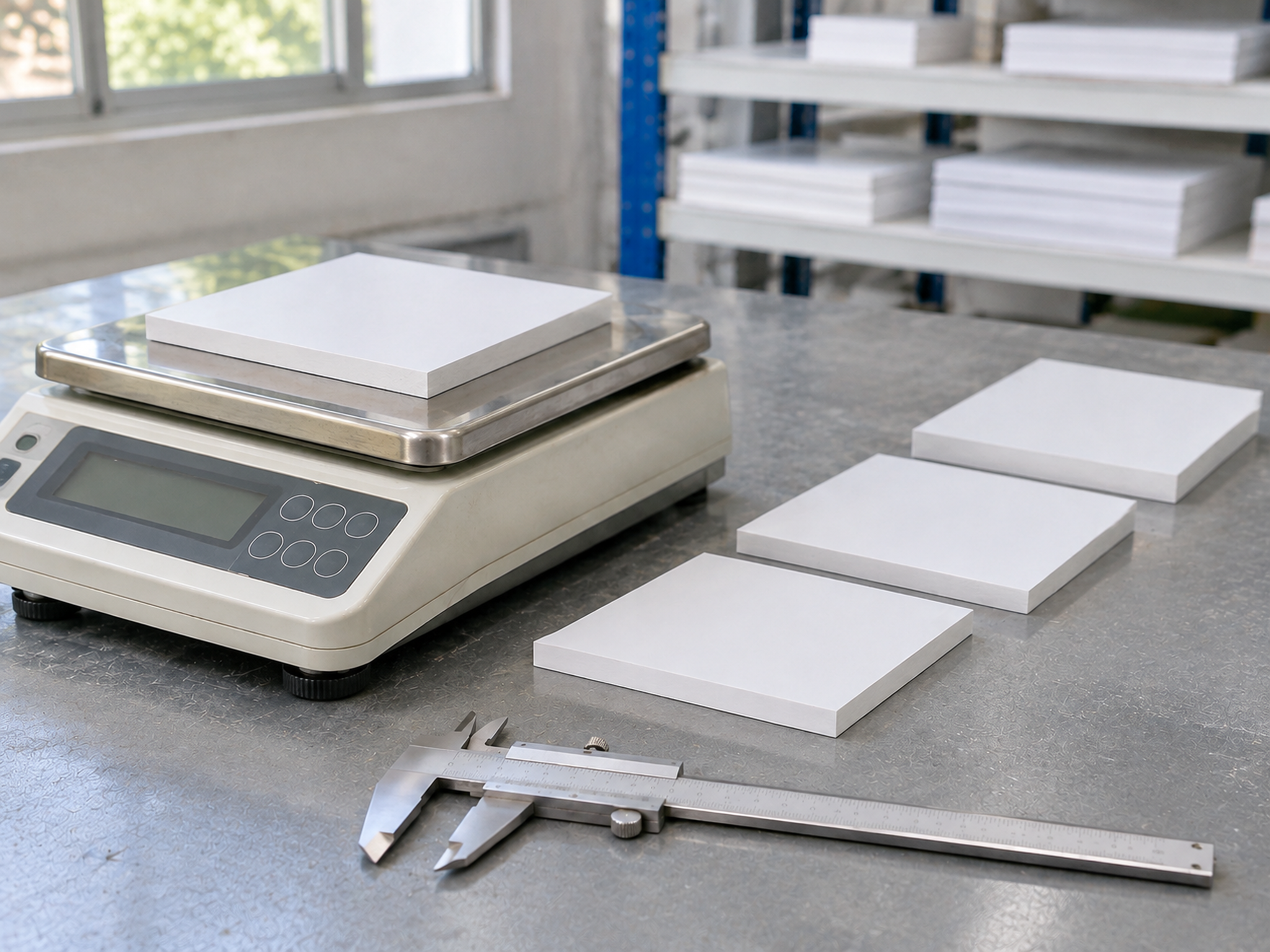
Figure 3. Verifying board density and thickness on a factory QC bench: weighing a precision-cut sample block on a balance and checking thickness with a vernier caliper.
5. How to Replace Trade Names with a 5-Line Purchase Specification
To eliminate ambiguity across languages and regional trade habits, replace brand nicknames in your RFQ and Proforma Invoice (PI) with this five-line specification:
- Process & Product Line — State Free Foam (PL-08), Celuka Integral-Skin (PL-01), Co-Extrusion (PL-04), WPC (PL-03) or PUR Laminated (PL-02).
- Nominal Density & Tolerance — Specify exact density in g/cm³ with an agreed tolerance (e.g. 0.55 g/cm³ ± 0.02 g/cm³).
- Thickness & Tolerance — Specify nominal thickness in mm and write the thickness tolerance into the PI.
- Sheet Dimensions & Colour — Standard 1220 × 2440 mm (4 × 8 ft) or custom cut-to-length; specify white, core/surface colour combination or Pantone reference.
- End-Use Application — State whether the board will be UV-printed, CNC-engraved, thermoformed or assembled with cabinet hinges and screws.
6. Frequently Asked Questions
What is the difference between Andy Board, Chevron Board and Celuka PVC board?
In Chinese export trade, “Andy Board” (安迪板) and “Chevron Board” (雪弗板) are informal trade nicknames for expanded PVC foam sheets — most often referring to lightweight 0.30–0.35 g/cm³ free-foam signage sheets, though some traders apply the words to any white PVC foam board. “Celuka” is a specific extrusion process (PL-01) that forms a dense, smooth outer skin (0.40–1.0 g/cm³) suitable for cabinetry and screw fixing. Always specify process and density rather than relying on nicknames.
Is Forex or Sintra the same thing as Celuka PVC foam board?
No. Forex and Sintra are proprietary third-party brand names that many buyers use generically to mean expanded PVC sheet, whereas Celuka describes the cooled-die integral-skin extrusion process. When a customer asks for “Forex” or “Sintra,” check their thickness (mm), target density (g/cm³), and whether they need a matte free-foam print surface (PL-08) or a hard integral skin (PL-01).
How can I check whether a delivered container matches the density I paid for?
Cut a rectangular sample piece cleanly, measure its length, width and thickness with a digital caliper to calculate volume in cm³, and weigh the piece on a gram scale (Density = Weight in grams ÷ Volume in cm³). Also inspect the saw-cut edge: a Celuka or co-extruded board has a visibly dense outer skin surrounding a fine, uniform closed-cell core.
Can Pluswin match a competitor’s sample if I only know its local trade name?
Yes. You can either send us the five-line specification above or courier a small physical cut-off of the board you are currently buying. Our QC lab will measure its exact process structure, density, thickness, hardness and colour, and quote the matching Pluswin specification (0.30 to 1.0 g/cm³).
Send Us the Trade Name — We Will Translate It Into a Specification
|
Holding a quotation or tender with a regional trade name? Send us the trade name, thickness, sheet size, application and target quantity (or a physical sample). Our engineering and export team will confirm the exact extrusion process, recommended density band and container loading count for your market. |
Hangzhou Jiaying Trade Co., Ltd. (Pluswin) — Manufacturer of Celuka, Free Foam, Co-Extrusion, WPC, Laminated, Marble UV and Wall Panel products since 2006 · Hangzhou, Zhejiang, China · Exporting to 96 countries.
Recommended Products

Hot News
-
How to Install PVC Foam Board on a Wall: Adhesives, Fixings and Expansion Gaps
2026-10-30
-
Meet PLUSWIN at the 140th Canton Fair
2026-10-26
-
Importing PVC and WPC Boards from China: Landed Cost, HS Codes and Customs Documents
2026-10-22
-
PVC and WPC Board Fire Ratings Explained: ECE R118, ASTM E84 and EN 13501-1
2026-10-22
-
How to Cut, Drill and Bend PVC Foam Board: A Complete Fabrication Guide
2026-09-24
-
PVC & WPC Foam Board FAQ
2026-09-24
-
PVC Foam Board & WPC Board FAQ: Products, Customization, Quality and Shipping
2026-09-08
-
How to Test the Quality of PVC Foam Board: A Practical Buyer’s Guide
2026-09-08
-
Luxury Without the Price Tag: How PVC Marble Sheets Are Redefining Modern Interior Aesthetics
2026-08-14
-
Discover the rigorous quality control process inside the PLUSWIN factory. Learn how we guarantee consistent thickness, zero formaldehyde, and superior durability in every PVC board batch
2026-07-21