

PVC Foam Board Compliance Dossier CE, REACH, RoHS, Prop 65 and UKCA Explained for Importers
|
The short answer Compliance is not a logo on a brochure — it is a test report tied to a specific standard, product, edition year and verifiable report number. We hold 13 active certifications and test reports issued by SGS, Intertek and FEMKO, including CE (EN 14041:2018), REACH-SVHC (2026 edition, 253 + 1 substances PASS), RoHS 2.0 (2026 edition, 10/10 PASS), Formaldehyde ND (< 0.080 mg/m³), ECE R118, ASTM E84-2024 and ISO 9001:2015. Full PDF reports are provided upon request with no NDA required and may be used for customs clearance, local registration and project tendering. |
When importing PVC foam board or WPC board into the European Union, the United Kingdom or North America, customs brokers, specifiers and retail compliance teams rarely ask whether a board is “eco-friendly.” They ask for a specific regulatory dossier: CE marking, REACH-SVHC, RoHS 2.0, California Proposition 65, CARB / TSCA Title VI formaldehyde status, or UKCA.
A missing, expired or unverifiable document can stall customs clearance or disqualify a bid at the specification stage. This dossier explains what each regulation actually governs for PVC foam boards, what test evidence Hangzhou Jiaying Trade Co., Ltd. (Pluswin) currently holds, what we do not hold, and how to verify every document before you place an order.
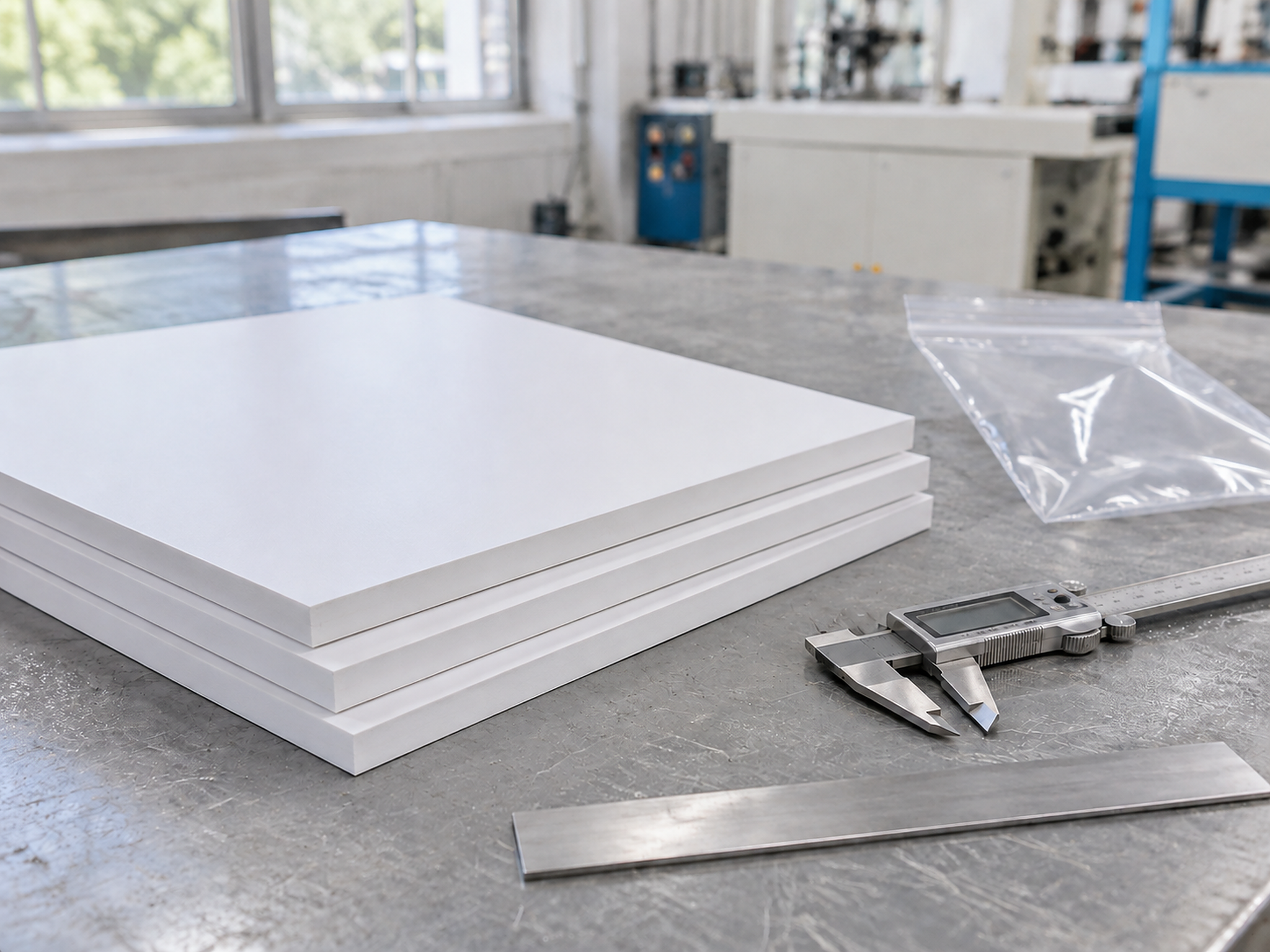
Figure 1. Precision-cut white PVC Celuka foam board compliance specimens prepared on a factory QC workbench for dimensional and laboratory verification.
1. Master Compliance Summary: What We Hold vs. What Can Be Arranged
Use this summary table to check our current standing across the five core regulatory frameworks and supporting safety standards:
|
Regulation / Standard |
Region / Scope |
Pluswin Status |
Issuing Body & Reference Detail |
|
CE Marking (EN 14041:2018) |
EU market entry (resilient panel/covering scope) |
Held (Certified) |
FEMKO · Cert. No. FMK.24/AC.C0021.01 · Models JY-T001 to JY-T030 · Valid to 22 Jan 2029 |
|
EU REACH (EC 1907/2006 — SVHC) |
EU chemical substances of very high concern |
Held (PASS) |
SGS Ningbo · 30 Mar 2026 · 253 candidate substances + 1 potential SVHC all ≤ 0.1% (w/w) (list to 4 Feb 2026) |
|
EU RoHS 2.0 (2011/65/EU + 2015/863) |
EU restriction of 10 hazardous substances |
Held (10/10 PASS) |
SGS Ningbo · 30 Mar 2026 · Pb, Hg, Cd, Cr6+, PBB, PBDE, DEHP, BBP, DBP, DIBP all PASS |
|
Formaldehyde (GB 18580-2017 E1 / CARB & TSCA context) |
Global indoor air quality & US composite-wood context |
Held (ND — Not Detected) |
SGS Shanghai · Report SHAEC25005892901 · < 0.080 mg/m³ (E1 limit 0.124 mg/m³); no urea-formaldehyde resin |
|
California Proposition 65 |
California, USA chemical exposure |
Supported by 2026 RoHS / REACH data |
RoHS 10/10 PASS (heavy metals & 4 ortho-phthalates) + REACH 253 SVHCs PASS; case-by-case review on request |
|
UKCA Marking |
Great Britain (England, Scotland, Wales) |
Not held standalone; arranged on request |
Joint third-party testing arranged on shared-cost basis (samples, factory docs & authorization provided) |
|
EN 13501-1 (EU Fire Classification) |
EU construction reaction-to-fire (e.g. B-s1,d0) |
Not held; arranged on request |
Third-party testing arranged jointly with buyer on shared-cost basis |
|
ECE R118 Rev.3:2023 (Annex 6 + 8) |
EU / UN vehicle interior burning behaviour |
Held (PASS — DNI) |
SGS Anji · 15 May 2025 · 16 mm PVC foam board · DNI (Does Not Ignite), burning rate 0 mm/min |
|
ASTM E84-2024 |
North America surface burning (IBC-referenced) |
Held (Class C) |
SGS Anji · 29 Jan 2026 · Report AJFTS26000009R01 · PVC co-extrusion board (PL-04) · FSI 120 · SDI 650 |
|
MSDS / SDS & CLP / OSHA HazCom |
Global transport & workplace chemical safety |
Held (No GHS Hazard) |
UN GHS Rev.10, EU CLP & OSHA HazCom 2012 · Non-dangerous goods (IMDG / IATA / ADR) · SDS-WPC-2026-001 & TDS-PVC-2026-001 v4.1 |
|
ISO 9001:2015 |
Factory quality management system |
Held (Certified) |
Intertek Apave · Cert. No. 29324Q118491R0S · Valid to 20 Nov 2027 (plus Intertek on-site verification Jan 2026) |
2. CE Marking: Understanding the Harmonised Standard (EN 14041:2018 vs. EN 13501-1)
In the European Union, “CE certified” is only meaningful when paired with the harmonised standard under which the certificate was issued. Different end uses trigger different EU requirements:
2.1 What We Hold: CE under EN 14041:2018
- Certificate Number: FMK.24/AC.C0021.01
- Issuing Notified Body: FEMKO
- Models Covered: JY-T001 through JY-T030
- Validity: Valid until 22 January 2029
- Format & Availability: Archived in both PDF and JPG formats; shipped with EU orders to support customs clearance and distributor documentation.
2.2 Where Buyers Must Check Scope: EN 13501-1 Fire Classification
If your PVC foam board will be installed as a permanent commercial wall or ceiling lining subject to a specific European reaction-to-fire classification (such as B-s1,d0 under EN 13501-1), a general CE certificate under EN 14041:2018 does not replace an EN 13501-1 fire test report.
|
Our transparent position on EN 13501-1 and ECE R118 We do not currently hold a standing EN 13501-1 report; when an EU building project requires it, we arrange accredited third-party testing jointly with the buyer on a shared-cost basis. For EU vehicle, bus and coach interiors, we hold a current ECE R118 Rev.3:2023 (Annex 6 + 8) report issued by SGS Anji on 15 May 2025 for 16 mm PVC foam board (DNI — Does Not Ignite, 0 mm/min). |
3. EU REACH (SVHC) and RoHS 2.0: Chemical Compliance in PVC Formulations
Why do chemical regulations matter so much for PVC foam board? Because older or low-grade PVC formulations in the market sometimes relied on lead-based thermal stabilisers (Pb), cadmium pigments (Cd), or restricted ortho-phthalate plasticisers (DEHP, BBP, DBP, DIBP). European importers, print-media distributors and furniture manufacturers require current laboratory proof that neither heavy metals nor Substances of Very High Concern exceed statutory limits.

Figure 2. White PVC foam board specimens prepared in glass petri dishes and stainless steel holders for chemical extraction and environmental chamber testing.
3.1 EU REACH-SVHC (Regulation (EC) No 1907/2006)
REACH-SVHC checks whether any substance on the European Chemicals Agency (ECHA) Candidate List is present in an article above the 0.1% weight-by-weight (w/w) threshold. Because ECHA updates the Candidate List roughly twice a year, older reports miss newly added substances.
Our current report was issued by SGS Ningbo on 30 March 2026, testing 253 candidate substances plus 1 potential SVHC (covering the ECHA Candidate List updated through 4 February 2026). Every tested substance is ≤ 0.1% (w/w) — PASS.
3.2 EU RoHS 2.0 (Directive 2011/65/EU + (EU) 2015/863)
Widely used by European signage, display and cabinetry buyers as the benchmark 10-substance chemical screen for rigid plastics, our current RoHS 2.0 report was issued by SGS Ningbo on 30 March 2026 and covers all 10 restricted substances:
- 4 Heavy Metals: Lead (Pb), Mercury (Hg), Cadmium (Cd), Hexavalent Chromium (Cr6+) — PASS
- 2 Brominated Flame Retardants: Polybrominated biphenyls (PBB), Polybrominated diphenyl ethers (PBDE) — PASS
- 4 Ortho-Phthalates: DEHP, BBP, DBP, DIBP — PASS
4. US Compliance: California Proposition 65, Formaldehyde (CARB / TSCA) & OSHA HazCom
Importers bringing PVC and WPC boards into the United States typically encounter four compliance checkpoints: California Proposition 65, formaldehyde emissions (CARB Phase 2 / TSCA Title VI), workplace/transport hazard rules (OSHA HazCom 2012), and commercial building fire codes (ASTM E84).
|
US Compliance Area |
Primary Concern |
Pluswin Evidence & Practical Guidance |
|
California Proposition 65 |
Chemical exposure warnings in California (commonly lead, cadmium and restricted phthalates in vinyl products) |
Our 2026 SGS RoHS 2.0 (10/10 PASS) and 2026 SGS REACH-SVHC (253 + 1 substances ≤ 0.1% w/w PASS) reports confirm that Pb, Cd, DEHP, BBP, DBP and DIBP pass strict EU limits. California buyers should verify specific end uses against the current Prop 65 list or request a product-specific review. |
|
Formaldehyde (CARB Phase 2 / TSCA Title VI) |
Urea-formaldehyde resin off-gassing in composite wood panels (MDF, particle board, plywood) |
PVC foam boards contain no urea-formaldehyde resin. Tested by SGS Shanghai (Report SHAEC25005892901 to GB 18580-2017 Class E1), formaldehyde emission is ND — Not Detected (< 0.080 mg/m³), well below the 0.124 mg/m³ E1 limit. |
|
OSHA HazCom 2012 & Freight Safety |
Workplace safety data sheets and dangerous-goods transport rules |
MSDS (3 Apr 2025) and SDS (SDS-WPC-2026-001, 29 Jun 2026) confirm no GHS hazard classification under 29 CFR 1910.1200 (OSHA HazCom 2012) and EU CLP. Not classified as dangerous goods for sea (IMDG), air (IATA) or road/rail (ADR/RID). |
|
IBC Commercial Fire Code (ASTM E84) |
Surface burning characteristics (FSI & SDI) |
PVC co-extrusion board (PL-04) tested by SGS Anji on 29 Jan 2026 to ASTM E84-2024 (Report AJFTS26000009R01): FSI 120 · SDI 650 · Class C. Used by customers to support US project approvals. |
5. UKCA: Post-Brexit Compliance for Great Britain
UKCA (UK Conformity Assessed) is Great Britain’s product marking framework covering England, Scotland and Wales. While UK rules have continued to recognise CE marking across many industrial and building product categories, some UK public-sector tenders or construction specifiers specifically request UKCA documentation or British Standard testing.
We state our UK position plainly: full CE (EN 14041:2018), REACH-SVHC (2026), RoHS 2.0 (2026), ECE R118 (2025), MSDS/SDS, TDS v4.1 and ISO 9001:2015 documents are immediately available on file. We do not currently hold a standalone UKCA certificate. When a UK project requires dedicated UKCA assessment, we coordinate accredited third-party testing jointly with the customer on a shared-cost basis, providing samples, factory documentation, audit cooperation and manufacturer authorization letters.
6. How to Audit a Supplier’s Compliance Dossier Before You Buy
Run this five-point check on every certificate or test report before you commit to a purchase order:
- Check the report date and list version — our REACH-SVHC and RoHS 2.0 reports are both dated 30 March 2026, covering the 4 February 2026 ECHA SVHC list.
- Match the tested product and thickness — confirm whether the report covers 16 mm PVC foam board (ECE R118), PVC co-extrusion board (ASTM E84) or your exact ordered product line.
- Verify the certificate or report number directly with the laboratory — ISO 9001:2015 (Intertek Apave 29324Q118491R0S), CE EN 14041:2018 (FEMKO FMK.24/AC.C0021.01), ASTM E84-2024 (SGS AJFTS26000009R01), Formaldehyde ND (SGS SHAEC25005892901), TDS v4.1 (TDS-PVC-2026-001) and WPC SDS (SDS-WPC-2026-001).
- Confirm document usage rights — under our policy confirmed on 15 August 2026, full PDF reports are provided upon request with no NDA required and may be submitted for local registration, customs clearance and project tendering.
- Tie laboratory compliance to pre-shipment QC — every Pluswin order undergoes pre-shipment inspection by an independent 5-person QC team checking dimensions, thickness, density, surface condition, colour and packing.
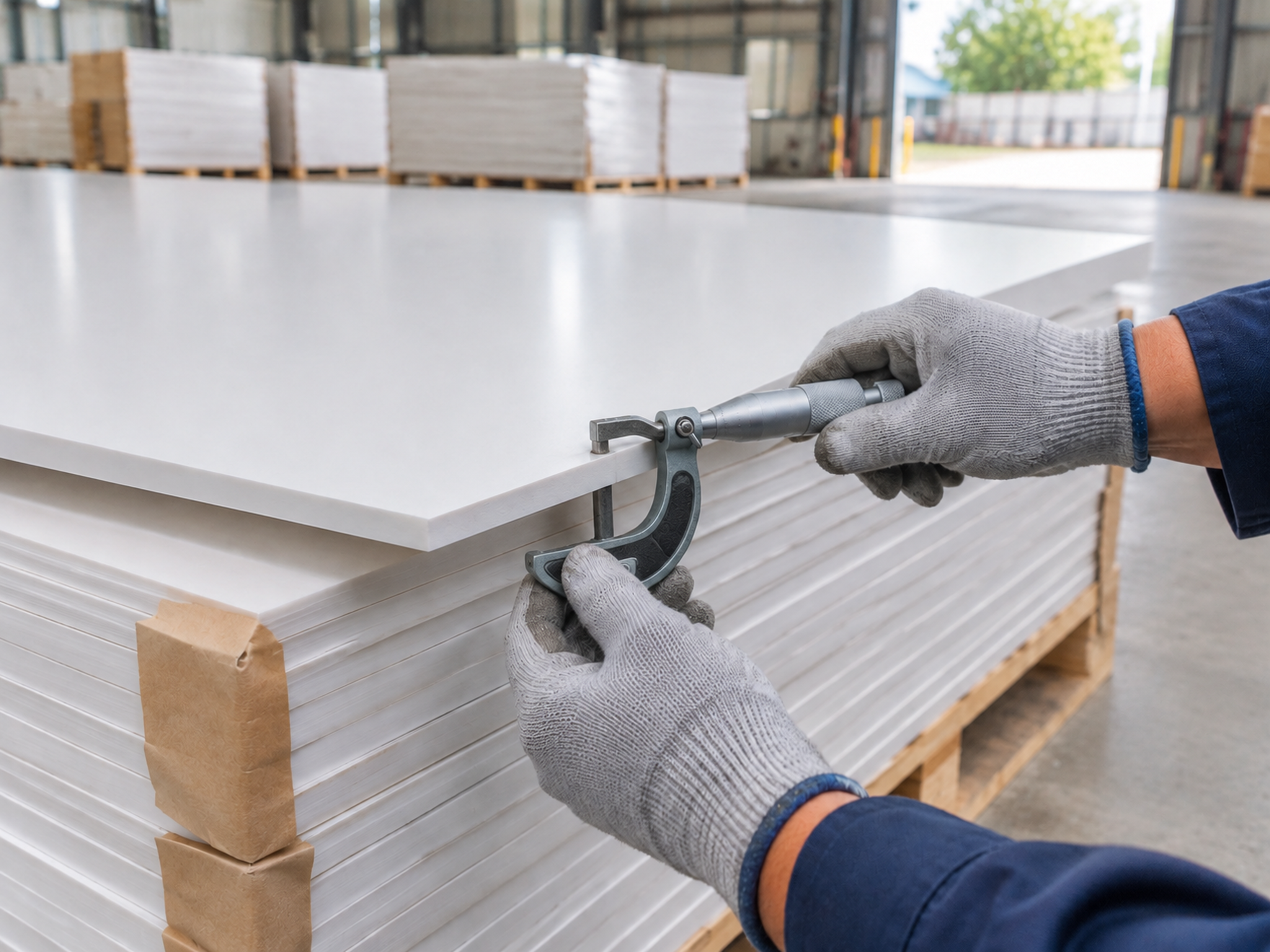
Figure 3. Pre-shipment thickness verification on stacked white PVC Celuka foam boards packed on a fumigation-free plywood pallet with kraft paper corner protectors.
7. Frequently Asked Questions
Can you send full PDF copies of your CE, REACH and RoHS reports before I place an order?
Yes. All 13 active certification and test reports are archived as full PDF scans (with JPG also available for the CE certificate and bilingual EN/ZH versions for ISO 9001:2015 and MSDS). We send the relevant reports upon request with no NDA required, and they can also be shipped with your order documents.
Can I use Pluswin’s test reports for local registration or government tenders in my country?
Yes. Buyers are permitted to submit our test reports, TDS v4.1 (TDS-PVC-2026-001) and SDS/MSDS for local regulatory registration, customs clearance and project tendering.
Does PVC foam board contain formaldehyde like MDF or particle board?
No. Unlike MDF, particle board and plywood — which rely on urea-formaldehyde or phenol-formaldehyde adhesives — PVC foam board is extruded without formaldehyde binders. In third-party testing by SGS Shanghai (SHAEC25005892901 under GB 18580-2017 Class E1), formaldehyde emission was ND — Not Detected (< 0.080 mg/m³).
Are your PVC and WPC boards classified as dangerous goods for sea or air freight?
No. Our MSDS (prepared to UN GHS Rev.10 and EU CLP Regulation (EC) No 1272/2008) confirms no GHS hazard classification. The boards are not classified as dangerous goods under IMDG (sea), IATA (air) or ADR/RID (road/rail), and our standard export pallets use fumigation-free plywood to avoid ISPM 15 solid-wood fumigation delays.
What if my project requires EN 13501-1 or UKCA certification?
We state clearly what we hold and what we do not hold: we do not currently hold a standalone EN 13501-1 or UKCA report. If your project requires either standard, we can arrange testing with an accredited third-party laboratory on a shared-cost basis, and our team will provide all required samples, factory documentation, audit cooperation and authorization letters.
Request the Compliance Dossier for Your Market
|
Need verifiable reports for customs or specification approval? Tell us your destination country, product type (Celuka, free foam, co-extrusion, laminated or WPC board), thickness, density and the standards your broker or specifier references. We will send the applicable full PDF reports, TDS v4.1 and SDS/MSDS so your team can verify them directly before ordering. |
Hangzhou Jiaying Trade Co., Ltd. (Pluswin) — PVC and WPC board manufacturer in Hangzhou, Zhejiang, China, established 2006 · Exporting to 96 countries · 13 active certifications and test reports issued by SGS, Intertek and FEMKO.
Recommended Products

Hot News
-
How to Install PVC Foam Board on a Wall: Adhesives, Fixings and Expansion Gaps
2026-10-30
-
Meet PLUSWIN at the 140th Canton Fair
2026-10-26
-
Importing PVC and WPC Boards from China: Landed Cost, HS Codes and Customs Documents
2026-10-22
-
PVC and WPC Board Fire Ratings Explained: ECE R118, ASTM E84 and EN 13501-1
2026-10-22
-
How to Cut, Drill and Bend PVC Foam Board: A Complete Fabrication Guide
2026-09-24
-
PVC & WPC Foam Board FAQ
2026-09-24
-
PVC Foam Board & WPC Board FAQ: Products, Customization, Quality and Shipping
2026-09-08
-
How to Test the Quality of PVC Foam Board: A Practical Buyer’s Guide
2026-09-08
-
Luxury Without the Price Tag: How PVC Marble Sheets Are Redefining Modern Interior Aesthetics
2026-08-14
-
Discover the rigorous quality control process inside the PLUSWIN factory. Learn how we guarantee consistent thickness, zero formaldehyde, and superior durability in every PVC board batch
2026-07-21