

PVC Foam Board vs MDF Which Is Better for Cabinets and Furniture?
|
The short answer Choose high-density PVC Celuka foam board (0.55–0.75 g/cm³), co-extrusion board or WPC board for bathroom vanities, kitchen sink base cabinets, laundry rooms, coastal/humid climates and zero-formaldehyde interior projects. Choose MDF only for dry indoor furniture requiring long unsupported horizontal shelf spans (> 800 mm) or lowest initial sheet cost in climate-controlled rooms. Many cabinet factories combine both: waterproof PVC/WPC boards for wet zones and carcasses, paired with matching PUR-laminated doors. |
Every cabinet manufacturer and building-material distributor eventually faces the same trade-off: MDF (Medium-Density Fibreboard) is familiar and inexpensive per sheet, yet a single plumbing leak, wet mop or humid monsoon season can swell its edges and trigger warranty claims. PVC foam board is waterproof and formaldehyde-free, but buyers rightly ask whether it holds cabinet hinges, resists sagging on wide shelves and machines on standard woodworking lines.
This engineering comparison evaluates PVC/WPC foam board vs. MDF across the metrics that actually govern cabinet performance — using third-party SGS test data from Hangzhou Jiaying Trade Co., Ltd. (Pluswin) alongside practical shop-floor design rules.
1. Head-to-Head Comparison: PVC Celuka / WPC Board vs. Standard MDF
|
Performance Dimension |
Pluswin Cabinet-Grade PVC / WPC Board (PL-01 / PL-03 / PL-04) |
Standard Raw / Melamine MDF (Industry Reference) |
Practical Winner for Cabinetry |
|
Nominal Density |
0.50–0.75 g/cm³ (Cabinet range; full range 0.40–1.0 g/cm³) |
~0.68–0.78 g/cm³ (Industry reference) |
PVC / WPC (Up to 20–40% lighter handling weight) |
|
Water Absorption & Swelling |
≤ 1.43% water absorption (TDS-PVC-2026-001); closed-cell structure does not swell, delaminate or rot |
High moisture sensitivity; unsealed cut edges and screw holes absorb water and swell irreversibly (~10–15%+ over 24h immersion) |
PVC / WPC (Decisive advantage in kitchens, bathrooms & humid climates) |
|
Screw & Hinge Holding (EN 320:2011) |
≥ 850 N (SGS-tested to EN 320:2011 on cabinet-density board) |
Good face screw holding when dry; degrades sharply once moisture enters screw holes |
Tie when dry / PVC wins in damp zones |
|
Flexural Strength & Stiffness |
Flexural strength 14.9–18.7 MPa · Flexural modulus 1,420 MPa (SGS ASTM D790) |
Higher elastic modulus (~2,200–3,000 MPa industry reference); stiffer over wide unsupported spans |
MDF for wide dry shelves (> 800 mm); PVC within standard cabinet spans (≤ 800 mm) |
|
Formaldehyde Emission |
ND — Not Detected (< 0.080 mg/m³), SGS Shanghai SHAEC25005892901 (GB 18580-2017 E1); zero urea-formaldehyde resin |
Manufactured with UF/MUF resins; requires strict batch control to meet CARB Phase 2 / TSCA Title VI or E1/E0 |
PVC / WPC (Inherently formaldehyde-free) |
|
Termite, Mould & Decay Resistance |
100% inorganic/polymer matrix — immune to termites, borers, fungi and rot |
Wood fibres are vulnerable to termites and fungal mould in damp sub-floors or tropical regions |
PVC / WPC |
|
Fire Behaviour |
Self-extinguishing · ECE R118 DNI (0 mm/min) · ASTM E84-2024 Class C (FSI 120 · SDI 650, PL-04) |
Combustible wood fibre unless treated with flame-retardant additives (FR-MDF) |
PVC / WPC |
|
Heat Resistance |
Thermoplastic (measured Vicat softening point 56 °C); keep away from direct uninsulated oven/stove heat |
Chars at higher temperatures; better dimensional stability near radiant heat sources |
MDF near uninsulated high-heat zones |
2. Water & Humidity: Why Wet-Area MDF Fails at the Cut Edge
In a showroom, melamine-faced MDF looks sealed. In a real kitchen or bathroom, cabinet panels are cut for plumbing pipes, drilled for shelf pins, notched for sink bowls and scribed against damp walls. Every cut exposes raw wood fibres.
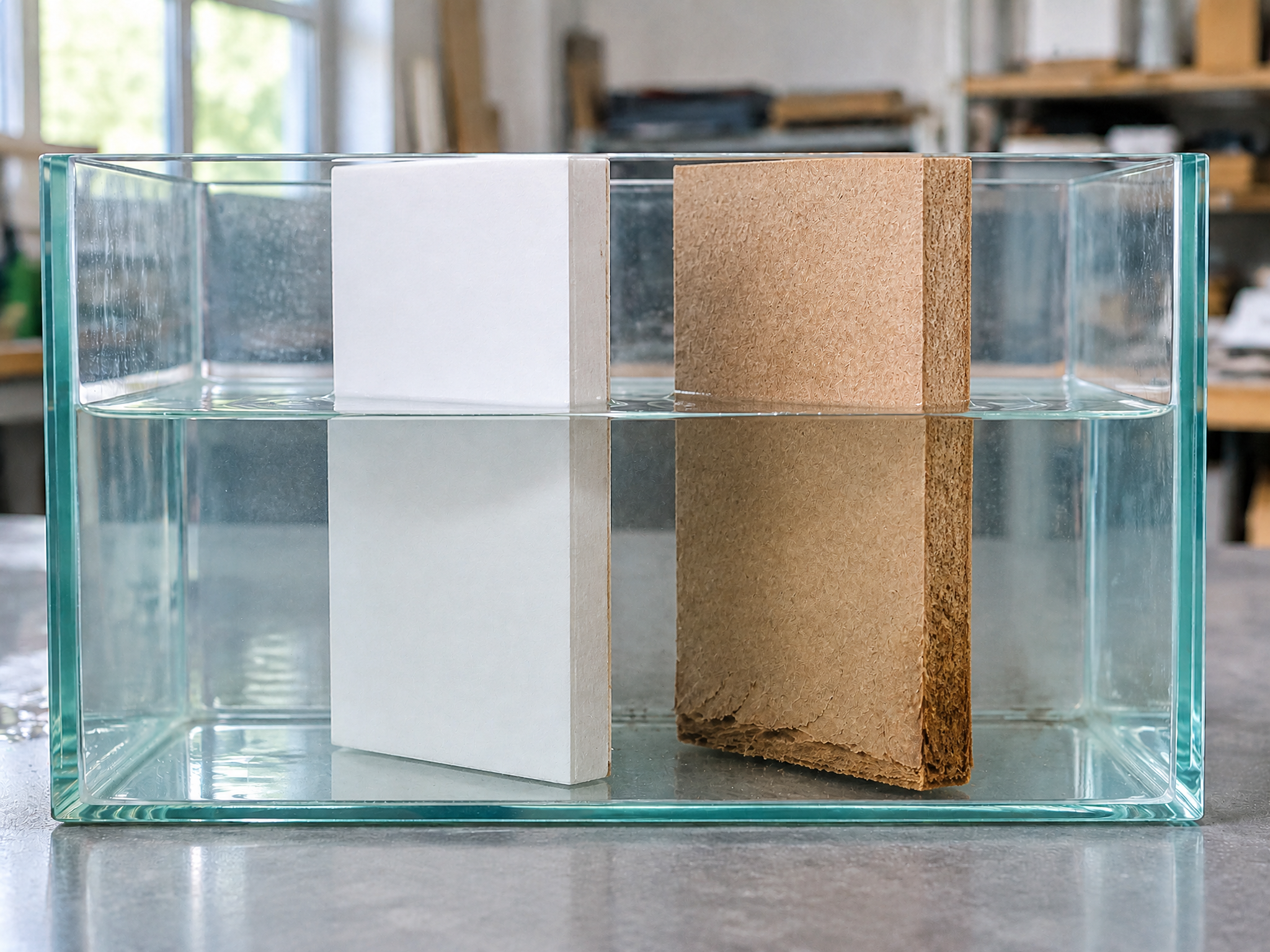
Figure 1. Side-by-side water immersion comparison: the 18 mm white PVC Celuka foam board (left) keeps crisp, unswollen edges underwater, while the 18 mm raw MDF sample (right) absorbs water, darkens and swells along the submerged wood-fibre edge.
Because PVC Celuka (PL-01), Co-Extrusion (PL-04) and WPC (PL-03) boards have a closed-cell structure, water cannot wick through the core. Even on an unbanded saw cut or plumbing cut-out, measured water absorption stays ≤ 1.43% (TDS-PVC-2026-001 v4.1). Although cabinet-grade PVC foam board has a higher material price per sheet than raw MDF, bathroom vanity manufacturers and project contractors eliminate water-damage replacements, waterproof sealing primers and tropical termite treatments.
3. Screw Holding, Hinges, and Structural Span Rules
The most common mistake first-time PVC cabinet makers make is buying a 0.35–0.40 g/cm³ signage board and trying to mount heavy kitchen doors on it. Low-density free-foam board (PL-08) is designed for UV printing, not cabinet hardware. When you specify the right process and density, PVC and WPC boards hold standard European cabinet hardware reliably.
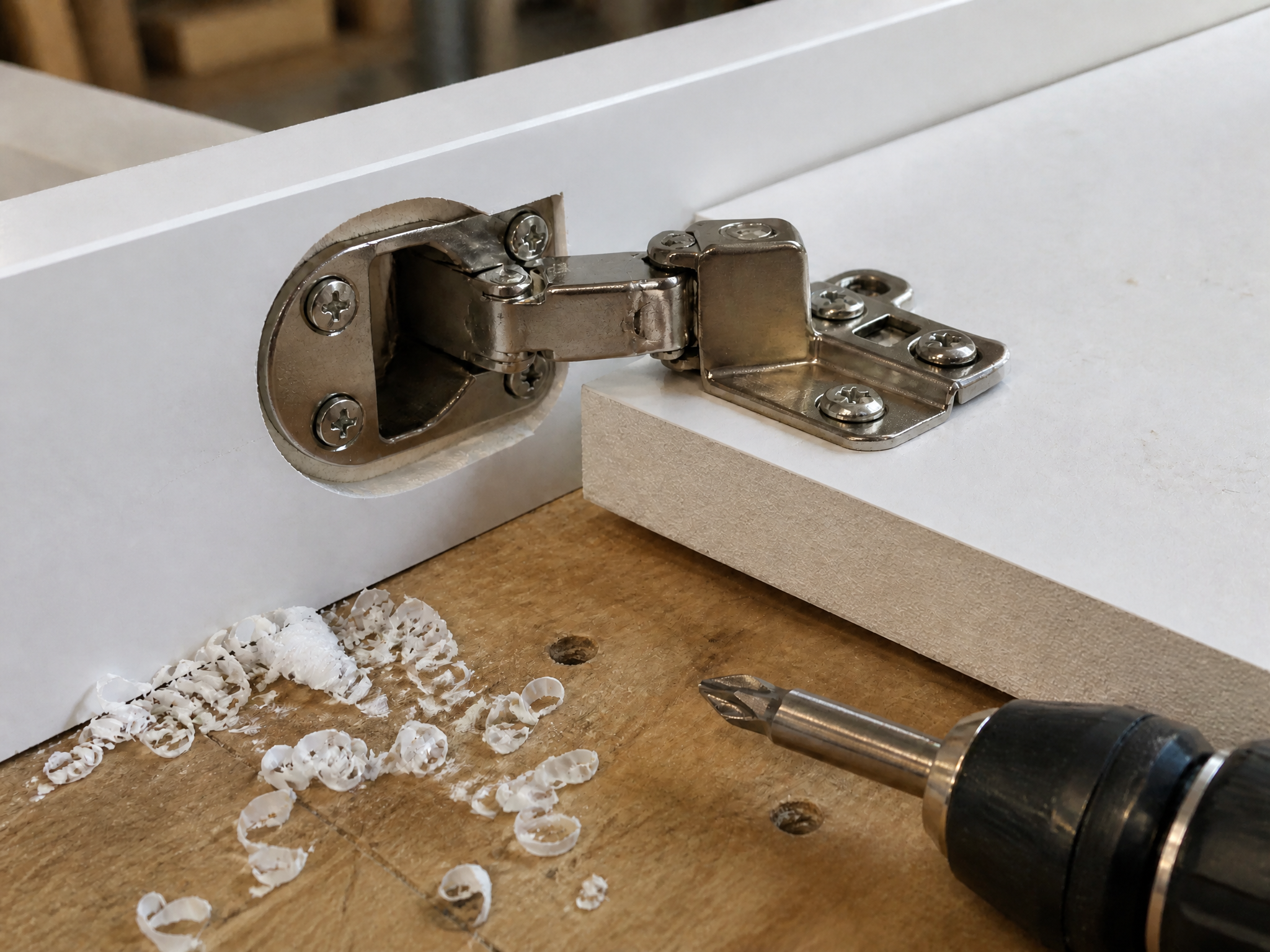
Figure 2. A 35 mm brushed stainless steel concealed cup hinge bored and screwed into an 18 mm cabinet-density white PVC Celuka foam board panel on a woodworking bench.
3.1 Verified SGS Mechanical Data for Cabinet Builders
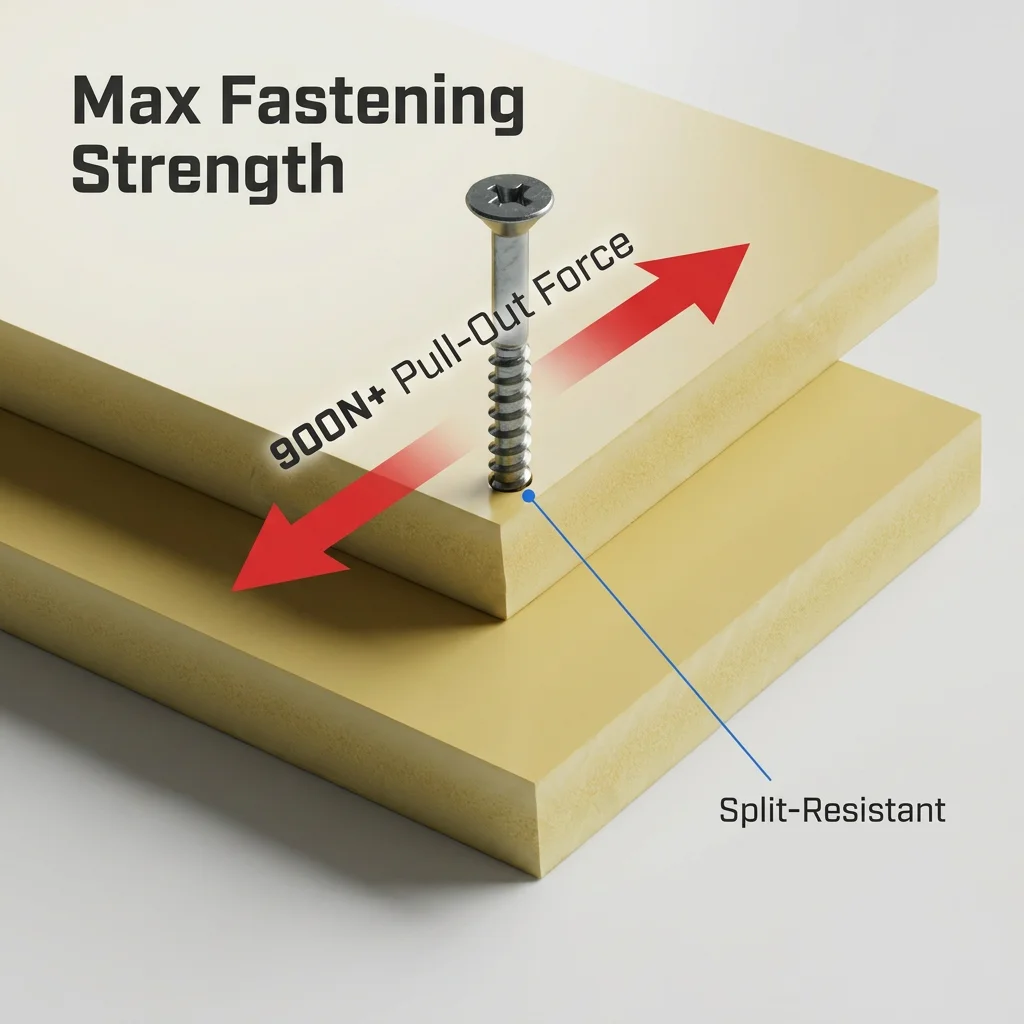
- Screw Withdrawal Force (EN 320:2011): Tested by SGS, Pluswin cabinet-grade boards achieve a screw/nail holding force of no less than 850 N (≥ 850 N). The dense integral skin (PL-01), co-extruded outer layer (PL-04) or wood-fibre composite matrix (PL-03) grips screw threads firmly without tearing around the hole.
- Bending Strength & Stiffness (ASTM D790): SGS testing confirms a flexural strength of 14.9 MPa (up to 18.7 MPa on high-strength grades) and a flexural modulus of 1,420 MPa.
3.2 Which Density to Specify for Each Cabinet Component
- Cabinet Carcasses, Doors, Drawer Fronts & Hinge Zones: Specify 0.55–0.75 g/cm³ in 15 mm, 16 mm, 17 mm or 18 mm thickness (PL-01 High-Density Celuka, PL-03 WPC, or PL-04 Co-Extrusion).
- Cabinet Back Panels & Drawer Bottoms: Specify 0.45–0.55 g/cm³ in 5 mm to 9 mm thickness.
- Heavy-Duty Countertop Substrates (under Quartz or Acrylic Solid Surface): Specify 0.70–1.0 g/cm³ in 18 mm to 25 mm thickness.
|
Three engineering boundaries you must respect 1) Keep unsupported horizontal shelf spans to ≤ 800 mm (use a centre divider or support batten for wider spans). 2) Isolate from sustained high radiant heat (measured Vicat softening point 56 °C; use standard heat shields beside ovens and cooktops). 3) Pre-drill near panel edges and set cordless drivers to moderate torque. |
4. Formaldehyde, Indoor Air Quality, and Machining on Standard Equipment
MDF and particle board rely on urea-formaldehyde (UF) or melamine-urea-formaldehyde (MUF) resins, which require continuous emission testing for CARB Phase 2, TSCA Title VI and E1/E0 indoor air regulations. Pluswin PVC and WPC boards contain no urea-formaldehyde resin. In third-party testing by SGS Shanghai (Report SHAEC25005892901 under GB 18580-2017 Class E1), formaldehyde emission tested ND — Not Detected (< 0.080 mg/m³).
Cabinet workshops do not need new machinery to switch from MDF to PVC or WPC board: standard fine-tooth carbide panel saws, CNC routers, drills and edge banders work directly. To save shop-floor labour, Pluswin also operates a 12-person in-house lamination workshop using moisture-proof PUR hot-melt adhesive to bond wood-grain, solid-colour, marble, fabric, metallic and high-gloss PET/PVC films onto PVC or WPC substrates (PL-02), complete with colour-matched PL-07 edge banding (1 × 19 mm, 1 × 22 mm, 1.2 × 22 mm).

Figure 3. Complete modular kitchen system combining upper wall cabinets, built-in appliances and lower base units — with the under-sink door open to show the waterproof white PVC Celuka cabinet carcass in the plumbing zone.
5. Application Decision Matrix: Where to Use PVC/WPC vs. MDF
|
Furniture / Cabinet Application |
Recommended Material |
Recommended Pluswin Spec |
Why |
|
Bathroom Vanities & Medicine Cabinets |
100% PVC Celuka (PL-01) or PUR Laminated (PL-02) |
15–18 mm · 0.55–0.65 g/cm³ |
Constant steam, wet floors and plumbing condensation rapidly destroy MDF edges |
|
Kitchen Sink Base & Dishwasher Units |
PVC Celuka (PL-01) or WPC (PL-03) |
16–18 mm · 0.55–0.70 g/cm³ |
Protects the highest-risk leak zone in the kitchen while holding heavy door hinges (≥ 850 N) |
|
Full Modular Kitchens in Tropical / Coastal Markets |
PUR Laminated PVC/WPC (PL-02 + PL-07 edge band) |
18 mm carcass & doors · 0.55–0.70 g/cm³ |
Eliminates monsoon humidity warping and termite damage across SEA, Middle East, Africa & LATAM |
|
CNC-Routed Shaker Doors & Curved Island Panels |
Celuka (PL-01) or Co-Extrusion (PL-04) |
18 mm · 0.60–0.75 g/cm³ |
Smooth dense skin routs cleanly and can be thermoformed (100–140 °C) into curved island ends |
|
Dry Bedroom Wardrobes & Wide Bookcases (> 800 mm span) |
MDF / Plywood — or WPC (PL-03) with centre divider |
If using WPC/PVC, keep shelf span ≤ 800 mm |
Dry living areas with wide heavy shelves favour higher-modulus wood panels unless mid-span support is added |
6. Frequently Asked Questions
Will cabinet hinges loosen over time in PVC foam board?
Not when you specify cabinet-grade density. Loose hinges happen when fabricators use low-density 0.35–0.45 g/cm³ signage board. At 0.55–0.75 g/cm³, Pluswin Celuka (PL-01), WPC (PL-03) and Co-Extrusion (PL-04) boards pass EN 320:2011 screw-withdrawal testing at ≥ 850 N (SGS-verified).
Should I choose PVC Celuka board or WPC foam board for kitchen cabinets?
Both are waterproof (≤ 1.43% water absorption) and formaldehyde-free (ND < 0.080 mg/m³). Choose PVC Celuka (PL-01) when you want a bright white, smooth, ready-to-use interior carcass or painted/UV-finished door. Choose WPC foam board (PL-03, 0.50–0.70 g/cm³) when your workshop prefers a more wood-like machining feel and extra fibre-reinforced screw grip.
How many 18 mm cabinet boards fit in a 40HQ container?
Because PVC board is heavy cargo, a 40HQ container reaches its weight limit (~28 tonnes) before its volume limit. Confirmed actual Pluswin 40HQ loadings include 940 sheets of 18 mm × 1220 × 2440 mm white board at 0.55 g/cm³, 1,100 sheets of 17 mm at 0.50 g/cm³, and 1,130 sheets of 15 mm at 0.55 g/cm³. Mixed-container orders combining white carcass boards, laminated door panels (PL-02) and edge banding (PL-07) are supported at no extra charge.
Can you supply free samples so our workshop can test hinge boring and edge banding?
Yes. Small test pieces in cabinet thicknesses (15 mm, 16 mm, 18 mm), densities (0.55–0.70 g/cm³) and laminated colour cards are available free of charge (buyer covers courier freight), normally dispatched within 2–3 days.
Request a Cabinet-Grade Sample Kit & Container Loading Plan
|
Switching part or all of your cabinet line from MDF to waterproof PVC or WPC board? Send us your cabinet application (kitchen sink base, bathroom vanity or full modular wardrobe), preferred thickness (15–18 mm), surface finish (raw white Celuka, WPC or PUR-laminated wood grain/solid colour) and destination port. We will recommend the right density, calculate your exact 40HQ mixed-container sheet count and dispatch a sample kit for your workshop to test. |
Hangzhou Jiaying Trade Co., Ltd. (Pluswin) — Manufacturer of PVC Celuka, WPC, Co-Extrusion and PUR-Laminated Cabinet Boards since 2006 · Hangzhou, Zhejiang, China · 13 active SGS, Intertek and FEMKO certifications.
Recommended Products

Hot News
-
How to Install PVC Foam Board on a Wall: Adhesives, Fixings and Expansion Gaps
2026-10-30
-
Meet PLUSWIN at the 140th Canton Fair
2026-10-26
-
Importing PVC and WPC Boards from China: Landed Cost, HS Codes and Customs Documents
2026-10-22
-
PVC and WPC Board Fire Ratings Explained: ECE R118, ASTM E84 and EN 13501-1
2026-10-22
-
How to Cut, Drill and Bend PVC Foam Board: A Complete Fabrication Guide
2026-09-24
-
PVC & WPC Foam Board FAQ
2026-09-24
-
PVC Foam Board & WPC Board FAQ: Products, Customization, Quality and Shipping
2026-09-08
-
How to Test the Quality of PVC Foam Board: A Practical Buyer’s Guide
2026-09-08
-
Luxury Without the Price Tag: How PVC Marble Sheets Are Redefining Modern Interior Aesthetics
2026-08-14
-
Discover the rigorous quality control process inside the PLUSWIN factory. Learn how we guarantee consistent thickness, zero formaldehyde, and superior durability in every PVC board batch
2026-07-21