

PVC Foam Board vs Aluminium Composite Panel (ACP) for Signage
The Ultimate B2B Buying & Comparison Guide
|
SEO META & PUBLISHING SPECIFICATIONS Meta Title: PVC Foam Board vs ACP for Signage: Comparison, Cost & Lifespan | B2B Buyer's Guide |
1. Introduction: Choosing the Right Substrate for Signage
In the commercial signage, architectural branding, and visual merchandising industries, selecting the right substrate determines not only the visual appeal of the finished project but also its structural integrity, fabrication efficiency, and total project margin.
Two of the most widely specified materials on the global market are Expanded Rigid PVC Foam Board (Celuka / Free-Foam Sheet) and Aluminium Composite Panels (ACP / ACM / Dibond). While both serve critical roles across indoor and outdoor signage applications, their material properties, weight ratios, processing characteristics, and cost structures differ substantially.
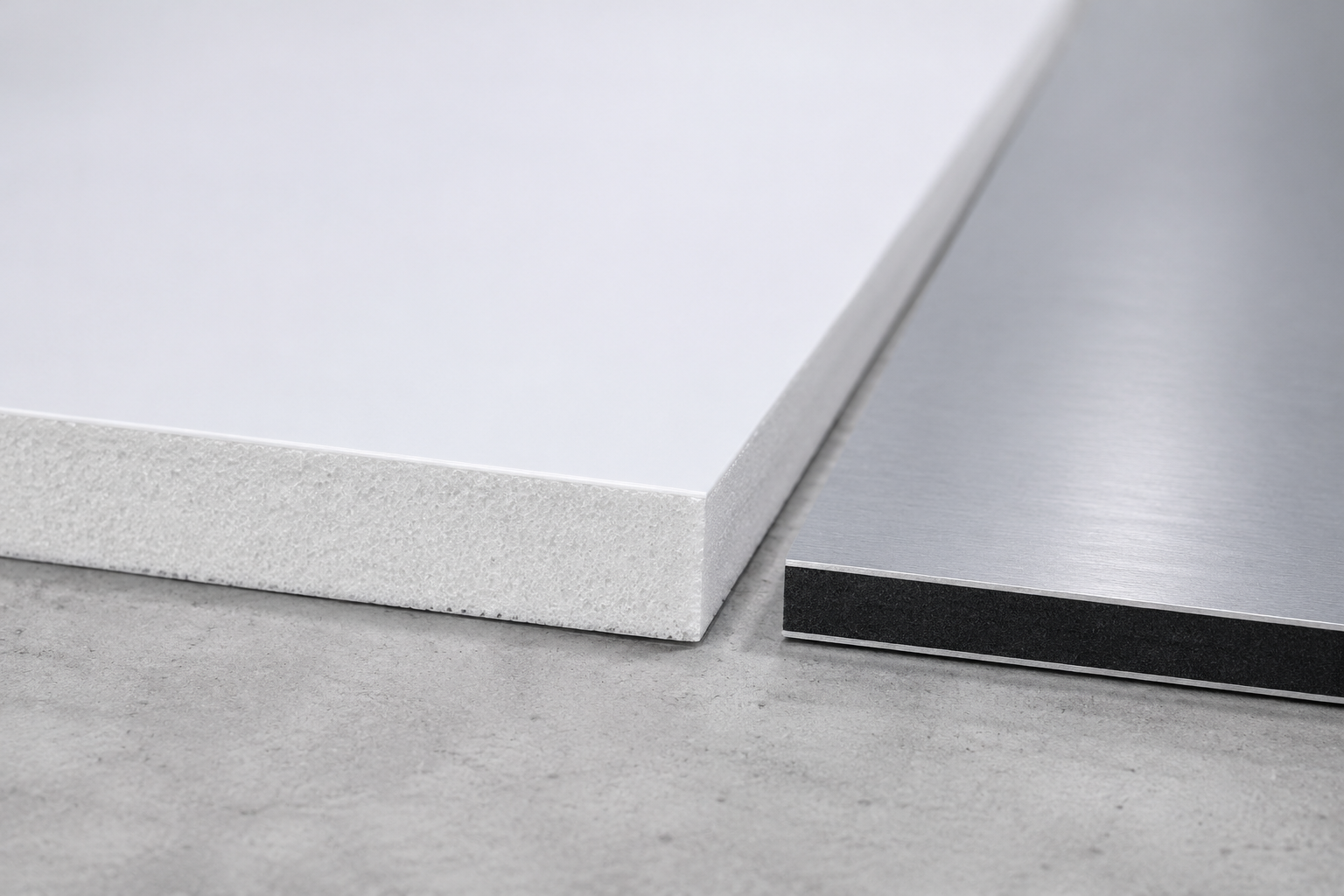
Figure 1: Cross-section comparison showing the 18mm solid micro-cellular closed-cell core of Rigid PVC Foam Board alongside the sandwich construction of an Aluminium Composite Panel (ACP).
2. Material Structure & Physical Characteristics
2.1 Rigid PVC Foam Board (18mm Profile)
- Composition: Extruded Polyvinyl Chloride with a closed micro-cellular internal structure and solid, smooth outer skins (Celuka or Free-foam process).
- Core Density: Typically ranges from 0.45 g/cm³ to 0.70 g/cm³ for standard commercial grades.
- Surface Quality: Silky semi-matte, ultra-flat surface ready for direct-to-substrate UV flatbed printing, vinyl lamination, or spray painting.
- Dimensional Relief: At 18mm thickness, PVC foam boards offer exceptional volumetric depth, making them the premier choice for 3D dimensional lettering, routed logos, and freestanding architectural sign elements.
2.2 Aluminium Composite Panel (ACP)
- Composition: A three-layer sandwich panel composed of two thin pre-painted aluminium sheets (0.15mm to 0.50mm) thermally bonded to a solid polyethylene (PE) or mineral-filled fire-retardant (FR) core.
- Standard Thickness: Typically manufactured in 3mm, 4mm, or 6mm overall thickness.
- Surface Quality: High-gloss, matte, brushed metal, or PVDF/PE coated finishes engineered for extreme flat rigidity.
3. Comprehensive Performance Comparison Matrix
|
Feature / Metric |
18mm Rigid PVC Foam Board |
3mm - 4mm Aluminium Composite Panel (ACP) |
|
Material Structure |
Homogeneous closed-cell micro-cellular PVC |
Sandwich: 2 Aluminium skins + Polyethylene/FR Core |
|
Volumetric 3D Depth |
Outstanding (18mm solid relief depth) |
Low (requires return folding/tray fabrication) |
|
Weight per m² |
Approx. 9.0 - 11.5 kg/m² (at 0.55 g/cm³) |
Approx. 3.8 - 5.5 kg/m² |
|
Surface Flatness |
High (Smooth semi-matte Celuka skin) |
Exceptional (Zero deflection across large spans) |
|
CNC Routing & Edge Finish |
Self-finishing smooth white edge; easily bevelled |
Requires edge folding, capping, or routing & folding |
|
Direct UV Flatbed Printing |
Excellent ink adhesion (no primer required) |
Excellent (corona-treated or polyester coating) |
|
Fastening & Screw Retention |
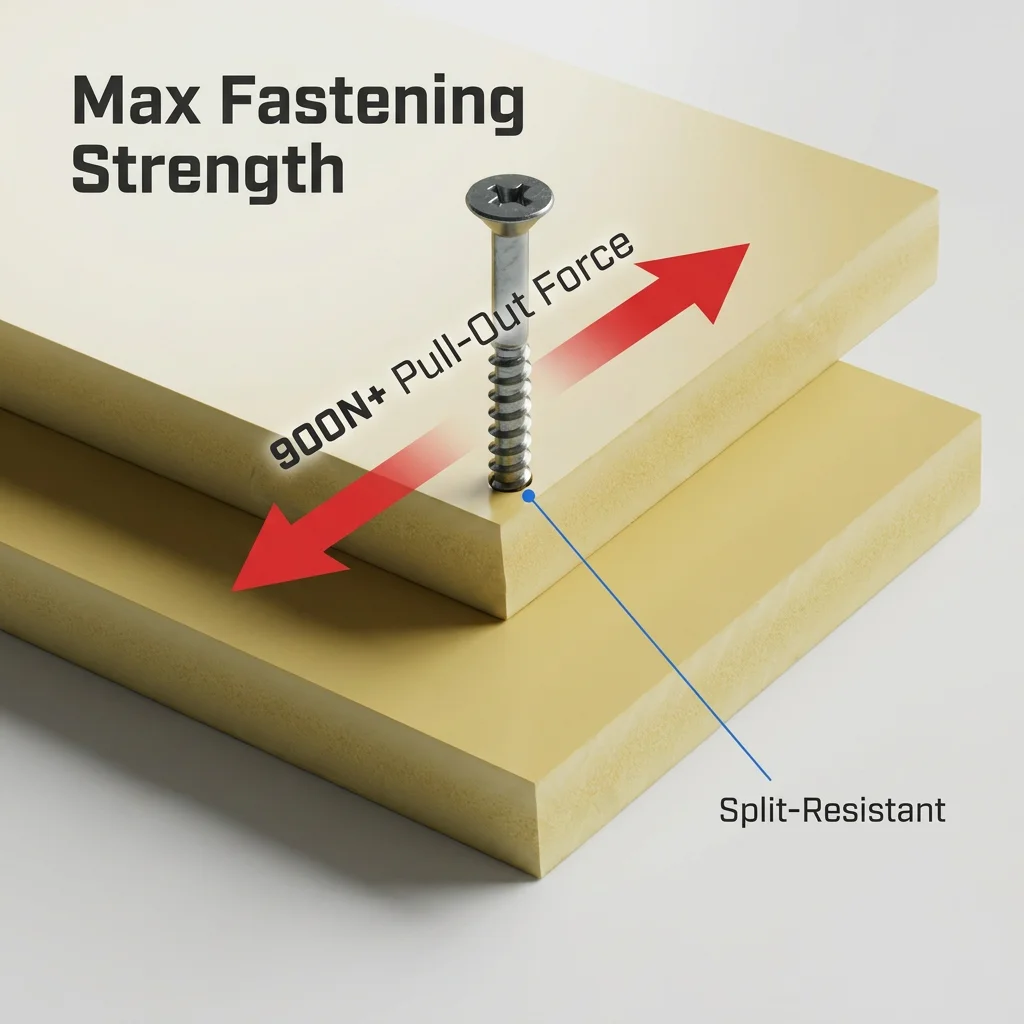
Excellent screw-holding power; accepts direct fixings |
Requires rivets, blind fasteners, or tray brackets |
|
Weather & UV Resistance |
Waterproof; requires UV paint for long outdoor use |
PVDF coating provides 10–15+ years outdoor life |
|
Thermal Expansion |
Moderate (approx. 0.06 - 0.08 mm/m/°C) |
Low (approx. 0.024 mm/m/°C) |
|
Fire Retardancy |
Self-extinguishing (Class B1 / UL94 V-0) |
Class B / Class A2 (with FR/Mineral Core) |
|
Raw Material Cost |
Economical per unit volume for 3D relief |
Moderate to High (dependent on aluminium skin) |
4. Fabrication, Machining, and Processing
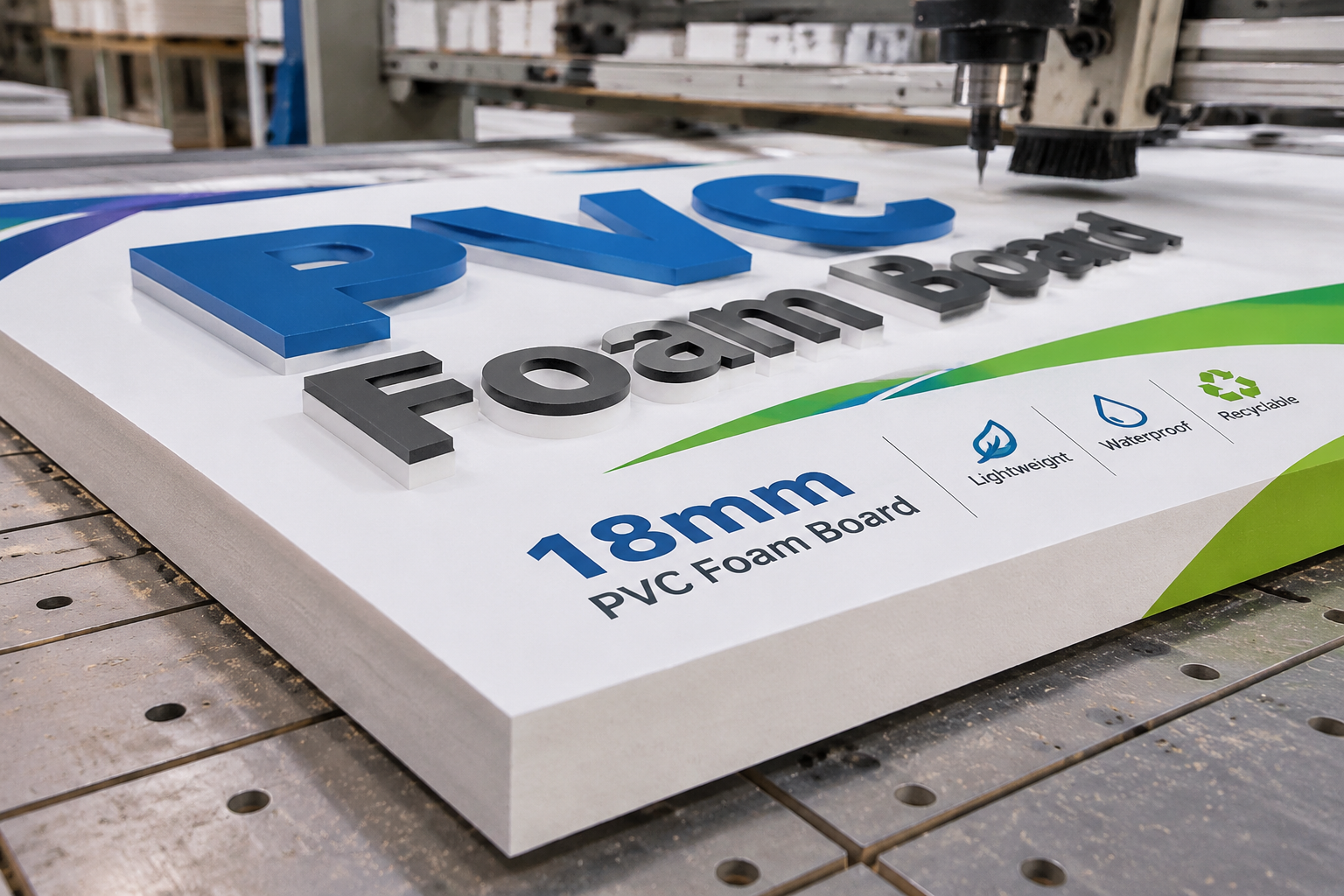
Figure 2: Precision CNC routing of 18mm PVC foam board for custom dimensional signage and direct UV printing in a commercial workshop.
4.1 CNC Routing & 3D Profiling
PVC Foam Board (18mm) routes like premium hardwood on standard 3-axis CNC router tables. Because the core is solid closed-cell foam with uniform density, machined edges remain smooth, solid, and burr-free. Tooling wear is minimal, allowing rapid cutting speeds (12 - 18 m/min) with single or double-flute carbide end mills.
ACP requires specialized V-grooving bits for folding, or composite-grade up-cut spiral router bits to prevent burring on the top and bottom aluminum skins. 3D dimensional lettering from ACP alone is rarely done without hollow box fabrication.
4.2 Direct Printing & Painting
The microporous surface structure of PVC foam board provides exceptional capillary grip for UV curable inks, solvent screen inks, and polyurethane spray finishes. Edges absorb paint smoothly without delaminating. ACP's factory-applied coil coating (PE or PVDF) guarantees uniform color consistency across thousands of square meters, ideal for corporate branding backdrops.
5. Typical Signage Application Scenarios

Figure 3: High-end architectural lobby signage combining 18mm painted PVC foam board 3D dimensional letters with a brushed aluminium composite panel (ACP) backdrop.
Best Applications for 18mm PVC Foam Board:
- 1. 3D Dimensional Cut Letters & Logos: Provides bold architectural depth and shadow lines without complex metal fabrication.
- 2. Indoor Retail & Exhibition POS Displays: Lightweight yet rigid enough to stand freely in retail kiosks, tradeshow booths, and event signs.
- 3. Point of Purchase (POP) Wall Graphics: Direct UV printed boards that can be cleanly screwed, glued, or hung directly onto walls.
- 4. Theme Park & Entertainment Props: Easy to carve, layer, sand, and paint for realistic textured backdrops.
Best Applications for Aluminium Composite Panel (ACP):
- 1. Large-Format Outdoor Billboard & Fascia Panels: High flexural strength ensures billboard faces remain perfectly flat under high wind loads.
- 2. Architectural Building Cladding & Canopy Facings: Long-term weather resistance with PVDF coatings for high-rise commercial structures.
- 3. Pylon & Monolith Sign Backings: Serving as structural face skins for illuminated cabinet signs and fuel station totems.
6. The Perfect Partnership: Hybrid Signage Systems
Modern sign makers frequently combine both substrates to create high-value, cost-efficient signage systems: ACP as the Sub-Structure / Backing Panel (providing flat, weather-resistant, wind-tolerant mounting backplates), and 18mm PVC Foam Board as the Dimensional Foreground (providing bold, eye-catching 3D dimensional letters, logos, and iconography mounted with high-bond VHB tape or stand-off fixings).
7. Procurement Checklist for B2B Importers
- Density Specification: Confirm board density (e.g., 0.55 g/cm³ vs 0.65 g/cm³) to match machining requirements.
- Lead-Free & RoHS Certification: Ensure compliance with EU/North American environmental safety standards.
- Thickness Tolerance: Ensure strict tolerance standards (e.g., 18mm ± 0.3mm).
- Surface Protection: Double-sided PE protective masking film to prevent surface scuffing during transit.
Recommended Products

Hot News
-
How to Install PVC Foam Board on a Wall: Adhesives, Fixings and Expansion Gaps
2026-10-30
-
Meet PLUSWIN at the 140th Canton Fair
2026-10-26
-
Importing PVC and WPC Boards from China: Landed Cost, HS Codes and Customs Documents
2026-10-22
-
PVC and WPC Board Fire Ratings Explained: ECE R118, ASTM E84 and EN 13501-1
2026-10-22
-
How to Cut, Drill and Bend PVC Foam Board: A Complete Fabrication Guide
2026-09-24
-
PVC & WPC Foam Board FAQ
2026-09-24
-
PVC Foam Board & WPC Board FAQ: Products, Customization, Quality and Shipping
2026-09-08
-
How to Test the Quality of PVC Foam Board: A Practical Buyer’s Guide
2026-09-08
-
Luxury Without the Price Tag: How PVC Marble Sheets Are Redefining Modern Interior Aesthetics
2026-08-14
-
Discover the rigorous quality control process inside the PLUSWIN factory. Learn how we guarantee consistent thickness, zero formaldehyde, and superior durability in every PVC board batch
2026-07-21