

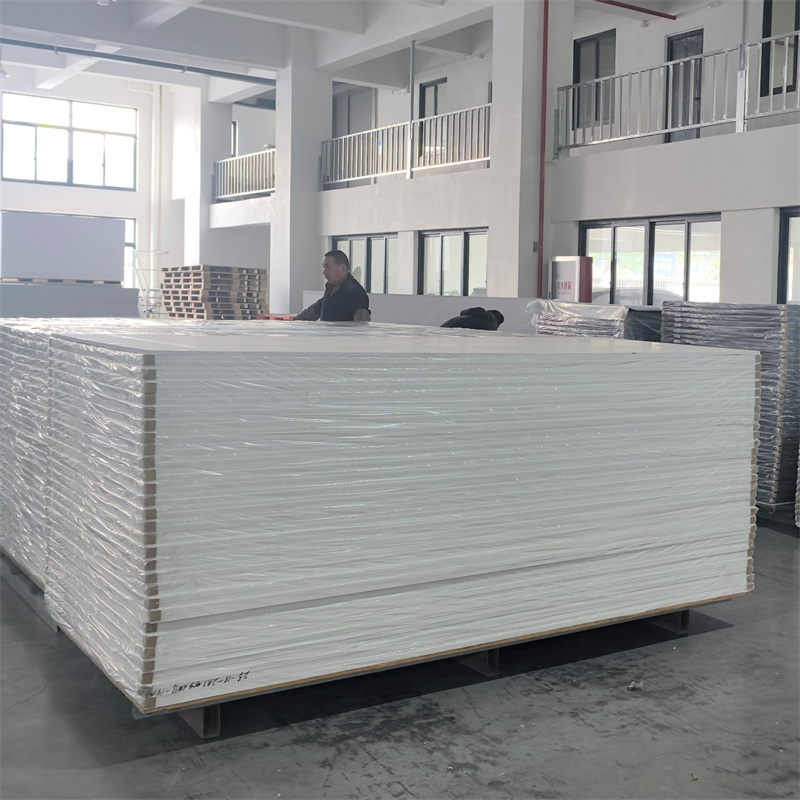
Where building materials are concerned, uniformity is essential. A distributor that accepts a shipment of PVC foam board which is not the same quality or density or surface finish as the previous order is dealing with unhappy customers, expensive returns and damage to the distributor's reputation. Often, a batch of inconsistent board can come off the press and stop an entire manufacturing line for a manufacturer of exhibition stands, kitchen cabinets or vehicle interiors. This is why Quality Control is not a minor matter, it is the most important skill for any PVC foam board factory. JIAYING (PLUSWIN) has a 19-year industry experience and over 10 years of successful export experience worldwide, leading with Quality PVC Foam Board, which performs the same batch after batch and year after year. This is an inside view of how a professional factory ensures product quality throughout the manufacturing process.
1. Raw Material Verification – Quality Begins Before the Extruder Starts
The key of making high quality PVC Foam Board is the material formula of the raw material. The PVC resin, calcium carbonate filler, foaming agents, stabilizers and processing aids have to be obtained from a qualified supplier, and tested before being introduced into the production line. The PVC Foam Board Factory with a reputation will not be able to rely on a supplier's certificate, it will check it.
JIAYING have a multiple point inspection process. The test parameters that are checked for PVC resin are K-value (which has an impact on the melt viscosity and foam structure), volatile content, and particle size distribution. The final board may have pinholes, discoloration or uneven cell structure if impurities or excessive moisture were found in the calcium carbonate, during purity testing. Foaming agents are measured for active content, as only a few percentage points of difference will change the density of the boards outside the specification.
A traceability code is given to each new batch and accompanies the batch throughout the manufacturing process. In case of quality problems later, the factory can quickly locate which lot of which raw material the problem occurred, which allows them to quickly identify the root cause and implement corrective measures.
2. In-Process Monitoring – Real-Time Control on the Extrusion Line
After production starts, quality is no longer verified in the laboratory; it is monitored in real-time within the process. The manufacturing process of a PVC Foam Board involves a continuous extruding process, which is a process used to mix, melt, and extrude raw materials through a die, calibrate and cool the extruded product. Variables that need to be controlled are introduced in each stage.
One of the most important of the extrusion temperature profile. A low melt temperature will give an incomplete foaming reaction, resulting in a dense and heavy board. If it is too high, the structure of the foam collapses so that the surface of the board is poor and the mechanical strength is reduced. All the extrusion lines in JIAYING have multi-zone temperature controller and laser thickness gauge, which can continuously measure the thickness of the board. The automatic adjustment of the deviation or line-stop alarm prevents defective material from reaching the downstream equipment.
Another important parameter is the density. Our inline density measurement system also confirms that the foamed sheet is within ±3% of target density, by either nuclear or gravimetric sensors. It is particularly important for those buyers who use volume or weight to calculate material costs, where this ensures the delivered product is always in line with the specified weight of 0.5 g/cm³ board.
Thickness and width tolerances are continuously measured with laser callipers. The standard tolerance is ±0.2 mm for thickness up to 20 mm, which is in line with the industry. These are recorded and stored at every production run to give a complete and full quality record, which can be supplied to customers on request.
3. Finished Product Testing – The Laboratory Verdict
Samples are taken from each production batch after extrusion, cooling and cutting to undergo extensive testing in the quality lab. This stage is used to confirm that the PVC Foam Board complies with all published specifications and customer requirements.
Key tests include:
Density and specific gravity: Verified by Analytical balances and Immersion method. In applications such as signage to furniture, the density has a direct effect on mechanical properties, thermal insulation and weight.
Tensile and flexural strength: These are tested on universal testing machines to ensure that the board is not prone to cracking under handling, installation or service loads nor will it become bent or deformed.
Surface hardness: Measured by Shore D durometer, which is necessary to prevent the board from being scratched or indented during manufacturing and use.
Water absorption and dimensional stability: samples placed in water for 24 hours, and then measured for swelling. Unlike wooden panels, a good PVC Foam Board is waterproof and does not show any dimensional change in water absorption, which should be less than 0.5%.
Fire performance: Boards are evaluated in terms of flame spread and smoke development and formulations are available to satisfy building code requirements.
Surface appearance and color consistency: Color appearance under standard lighting and color uniformity to ensure that no streaks, bubbles, or color variation which might have an impact on lamination, printing, or painting.
Additionally, at JIAYING, every batch is examined for screw holding capacity and bonding power which are important factors in screw assembly of the board by fabricators to make the final product.
4. Traceability, Packaging, and Continuous Improvement
Once the board passes laboratory testing, the work of quality control is not done. It permeates the entire product life cycle – from packaging to storage and transportation – and is part of a continuous process of improvement.
Each board made in a professional PVC Foam Board Factory is equipped with an identification mark, batch number, producing date and line identifier, which can make full traceability from the raw material to the delivery to the customer. This is particularly important when processing warranty claims and for narrowing down problems in the field if a defect occurs.
The packaging is intended to protect the board while in transit. Interleaved and protected by moisture barrier film, stacked on stable pallets. JIAYING has been doing export business for over 10 years and has paid attention to corner protectors and edge guards on the export shipment that can avoid damage when loading the container and transit in the ocean.
Last but not least, quality data is compiled from all production runs and analyzed. Corrective actions are taken at the root of the problem and trends discussed in weekly quality meetings. That is why JIAYING has been able to keep its products' quality consistently high from millions of boards sent to customers in Europe, North America, the Middle East and Southeast Asia.
Conclusion – Quality Is a System, Not a Slogan
What separates high-quality, dependable PVC Foam Board from substandard products are not accidents or single inspection checks, but rather a system. Our system-using confirmed raw materials, controlled extrusion settings, uncompromising quality checks and lab tests, and traceable and verified documentation-combined with nearly two decades worth of industry experience and a decade of export and fulfillment excellence to international distributors is why at JIAYING (PLUSWIN) the manufacturing of PVC Foam Board, Laminated Board, Wall Panel and WPC Foam Board is something our clients trust globally, one order at a time. Give us a call or message us today to learn about the many systems we put in place or order a sample for your next project.