

Wall Panel Problems: Why Panels Lift, Bubble or Rattle
Executive Summary: Failure Happens in the First Ten Minutes
Flat PVC decorative wall panels (paint-free boards) almost never deteriorate slowly—they lift at corners, develop surface blisters, or release from the wall entirely. Each observable symptom points directly to a specific installation mistake committed in the first ten minutes of fixing.
The true value of diagnostic engineering is identifying the exact underlying root cause: the repair method differs drastically for each scenario, and one critical failure mode has no on-site repair at all.
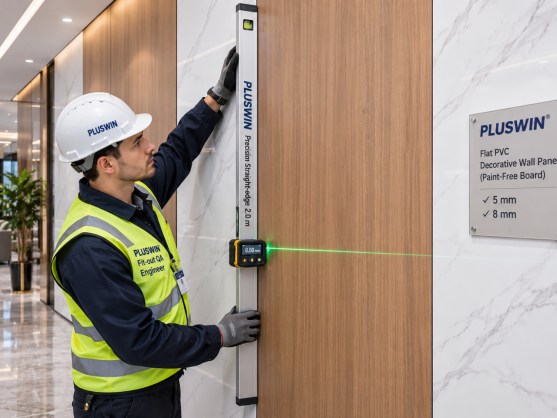
Professional fit-out quality assurance engineer inspecting surface flatness, seam alignment, and perimeter expansion gaps of full-height PLUSWIN flat PVC decorative wall panels (5mm & 8mm).
1. Corner Lift Within the First Week
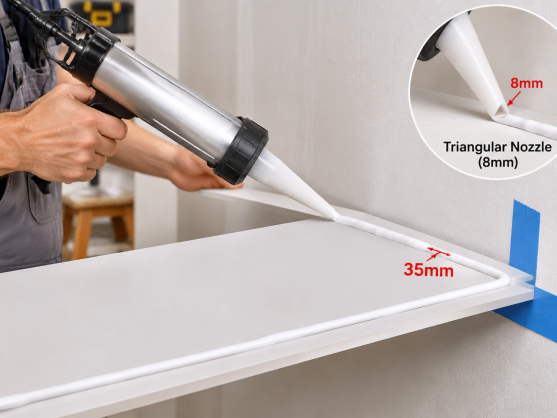
Fig. 1 — Corner bonding engineering: Extruding MS polymer adhesive bead at the required 35 mm setback on the flat rear face of a 5mm/8mm PVC wall panel, supported with high-tack temporary tape during initial cure.
Corner peeling typically manifests near high-traffic zones—adjacent to doors, windows, or HVAC supply vents where air drafts and physical vibrations work the panel hardest.
Underlying Root Causes:
1. Bead Laid Too Far Out or Missed: If adhesive is applied too close to the outer edge, it squeezes out into the joint; if omitted, the perimeter corner is left completely unsupported.
2. Pressed After Skinning ("Green Grab Loss"): If the panel is mounted after the adhesive bead has formed a skin (past its 10–15 min open time), pressing produces zero mechanical grip.
Field Repair Protocol:
- Do NOT attempt blind adhesive injection: Injecting glue through a lifted corner cannot guarantee bead consolidation and will inevitably fail again.
- The Correct Method: Carefully demount the panel, scrape adhesive from both substrate and panel back, lightly abrade the PVC rear face, and apply fresh MS polymer beads set back strictly 35 mm from all edges. Re-mount within 10 minutes and secure with temporary high-tack tape for 24 hours.
2. Hollow Drumming Sound or Rattle When Tapped
Tapping the centre of a flat panel produces a hollow, dead echo instead of a solid masonry ring.
Underlying Root Causes:
- Excessive Bead Spacing (>300 mm): On flat 5mm panels, wide bead spacing leaves large unsupported spans.
- Out-of-Plumb Substrate (>3 mm): Depressions in the wall prevent the extruded bead from making physical contact with the masonry.
Field Repair Protocol:
- If the panel is firmly bonded around perimeters: Install concealed stainless steel mechanical clips at 400 mm vertical centres along the tongue-and-groove joint to pull the panel flat against framing.
- For thin 5mm corridor panels: If drumming is severe, drill a discrete 2 mm injection port in the joint groove, inject low-viscosity structural MS polymer, compress flush, and seal with neutral silicone.
3. Surface Blisters, Ripples, or Bead Telegraphing (FATAL CHEMICAL DAMAGE)
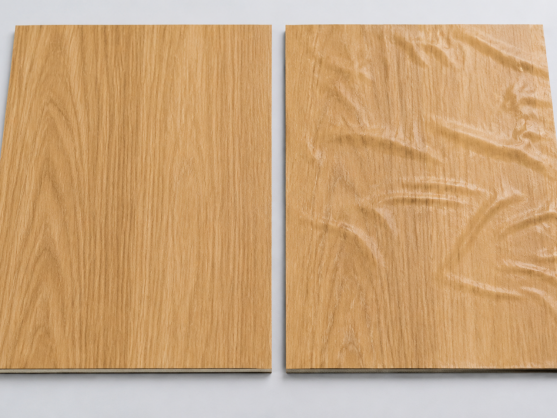
Fig. 2 — Laboratory chemical testing: Left sample bonded with 100% solvent-free MS polymer maintains a pristine, mirror-flat decorative surface. Right sample attacked by solvent-based neoprene adhesive displays permanent surface blisters and ripples.
|
⚠️ CRITICAL WARNING: Non-Repairable Chemical Deformation This is the single failure mode that CANNOT be repaired. The decorative face suffers irreversible physical deformation, and no amount of clamping or re-gluing will restore it. |
Underlying Root Cause:
- Chemical Attack from Solvent Adhesives: Generic contact adhesives and rubber-based glues contain aggressive volatile aromatic solvents. These solvents chemically soften and dissolve the thermoplastic PVC core, causing the laminated decorative film to wrinkle and blister.
- Expanding PU Foam Distortion: Low-density expanding polyurethane foams expand violently during cure, pushing thin 5mm skins outward and telegraphing uneven bead witness lines.
Field Repair Protocol:
- Total Replacement Required: Demount the compromised panel, thoroughly scrape all chemical residue from the substrate, and dispose of the sheet.
- Offcut Testing Rule: Always perform a 24-hour test on a small PVC offcut before doing a full wall. If ripples appear, change adhesive immediately to 100% solvent-free MS polymer.
4. Summer Thermal Bowing & Buckling
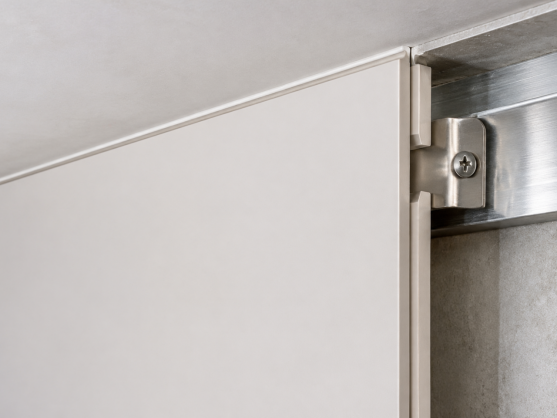
Fig. 3 — Thermal movement accommodation: Smoothly tooled 3–5 mm perimeter expansion joint at ceiling line combined with concealed stainless steel mechanical clips securing the 8mm flat PVC panel.
Panels installed perfectly flat in winter bow outward by mid-summer. Nothing changed except the ambient temperature, and the panels ran out of expansion room.
Underlying Root Cause:
Absence of 3–5 mm Perimeter Expansion Gaps: Like all thermoplastics, PVC expands with heat (~0.07 mm/m/°C). When constrained tightly between floor and ceiling, thermal expansion forces the panel to buckle outward.
Field Repair Protocol:
- Trim Constrained Ends: Use an oscillating multi-tool with a fine plastic blade to trim 3 mm to 5 mm off the constrained ceiling or corner edge.
- Re-Seal Joint: Press the panel flat and re-seal the joint with flexible neutral-cure silicone. Inspect all adjacent panels along the run to ensure uniform expansion clearance.
5. Adhesive Release After Several Months
Panels hold securely throughout the first few months and then release cleanly during humid seasons or after temperature swings.
Diagnosis from the Panel Back:
- Clean Panel Back: If the adhesive remained on the wall while the panel back is completely clean, the failure was caused by dust, efflorescence, grease, or lack of panel surface acclimatization.
- Adhesive Stuck to Panel Back: If the glue pulled the paint or plaster off the wall, the failure occurred inside a weak masonry substrate.
Field Repair Protocol:
- Substrate Remediation: Strip compromised panels back to sound masonry, verify moisture <4% with a digital meter, and apply a penetrating primer to consolidate chalky plaster before re-bonding.
6. Yellow / Brown Joint Staining & Discoloration
Yellowish or brown discoloration tracking along panel joints with a dull, etched halo across the decorative surface.
Underlying Root Cause:
Use of Acid-Cure (Acetoxy) Silicone: Acidic byproduct (acetic acid) released during curing chemically attacks and etches the PVC decorative foil.
Field Repair Protocol:
- Remediation: Cut out the acidic silicone sealant completely, clean surface residues immediately with 99% isopropyl alcohol (IPA), and re-seal exclusively with low-modulus neutral-cure silicone. If etching penetrated into the film, replace the sheet.
7. Master Repair vs. Replace Decision Matrix
|
Observed Symptom |
Underlying Root Cause |
Repairable? |
Recommended Field Action |
|
Corner Lift (Face Intact) |
Edge bead missing or pressed after skinning. |
YES |
Demount, clean, re-bead at 35 mm setback, secure with tape for 24h. |
|
Hollow Drumming / Rattle |
Excessive bead spacing or wall hollow. |
YES |
Add concealed stainless steel mechanical clips at 400 mm centres along tongue. |
|
Surface Blisters / Ripples |
Chemical attack (Solvent glue / PU foam). |
NO (REPLACE) |
Irreversible deformation. Replace sheet; switch strictly to MS Polymer. |
|
Summer Thermal Bowing |
Missing 3–5 mm perimeter expansion gaps. |
YES |
Trim 3–5 mm with oscillating multi-tool; re-seal with neutral silicone. |
|
Late Adhesive Release |
Substrate contamination or weak plaster. |
CONDITIONAL |
Scrape to sound substrate, verify moisture <4%, prime wall, and re-fix. |
|
Joint Staining & Halos |
Acid-cure silicone chemical etching. |
PARTIAL |
Clean surface with 99% IPA and re-seal with neutral silicone; replace if etched. |
8. The 5-Minute Pre-Installation Prevention Checklist
|
? 5-Minute Quality Gate Checklist 1. 2m Straight-Edge Check: Is the substrate flat within 3 mm over a 2 m span? 2. Dust & Moisture Inspection: Is the wall clean, bone-dry (<4% moisture), and dust-free? 3. Paint Adhesion Scratch Test: Does existing paint flake when cross-hatched with a utility blade? 4. Adhesive Compatibility Offcut Test: Does the adhesive cure on a scrap PVC offcut without wrinkling the decorative face? 5. Bead Layout Discipline: Are beads set back 35 mm from edges and spaced at 200–250 mm centres? |
9. Technical Support & Replacement Specification
If an existing installation is experiencing issues, send high-resolution photographs of the joint, corner, and panel back to our engineering desk. We will diagnose whether it can be repaired on-site before you order replacements.
|
PLUSWIN Engineering Services Manufacturer: Hangzhou Jiaying Trade Co., Ltd. (PLUSWIN Brand) Engineering Support: [email protected] Official Website: https://www.hzpluswin.com Global Port Dispatch: Ningbo / Shanghai, China |
Recommended Products

Hot News
-
How to Install PVC Foam Board on a Wall: Adhesives, Fixings and Expansion Gaps
2026-10-30
-
Importing PVC and WPC Boards from China: Landed Cost, HS Codes and Customs Documents
2026-10-22
-
PVC and WPC Board Fire Ratings Explained: ECE R118, ASTM E84 and EN 13501-1
2026-10-22
-
How to Cut, Drill and Bend PVC Foam Board: A Complete Fabrication Guide
2026-09-24
-
PVC & WPC Foam Board FAQ
2026-09-24
-
PVC Foam Board & WPC Board FAQ: Products, Customization, Quality and Shipping
2026-09-08
-
How to Test the Quality of PVC Foam Board: A Practical Buyer’s Guide
2026-09-08
-
Luxury Without the Price Tag: How PVC Marble Sheets Are Redefining Modern Interior Aesthetics
2026-08-14
-
Discover the rigorous quality control process inside the PLUSWIN factory. Learn how we guarantee consistent thickness, zero formaldehyde, and superior durability in every PVC board batch
2026-07-21
-
CustomSize PVC Foam Boards from Professional Manufacturer JIAYING PLUSWIN
2026-06-05