

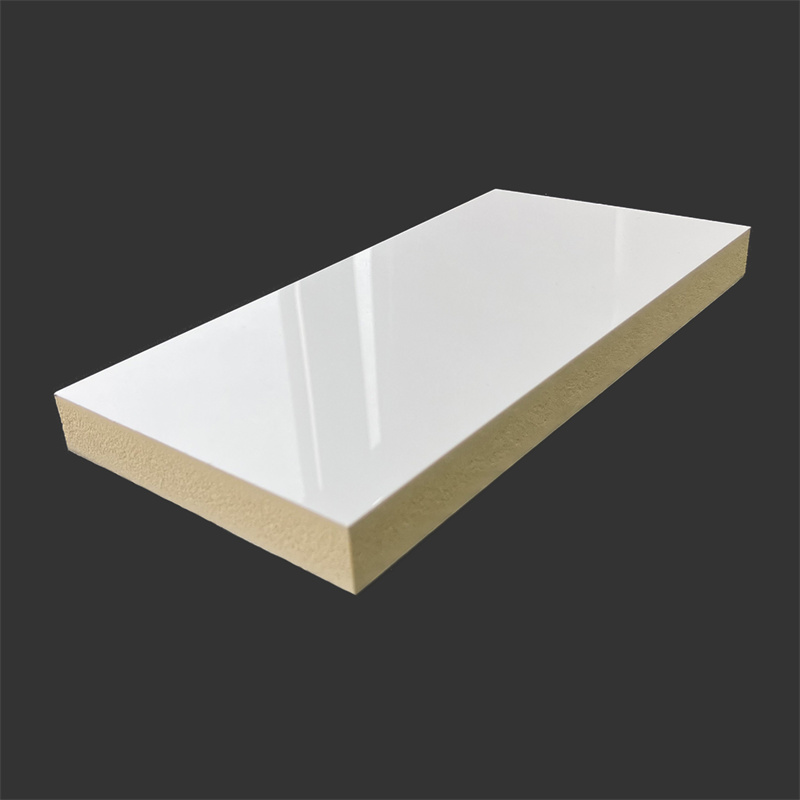
The two most important parameters that affect PVC foam board performance are density and thickness when specifying it for a project. However, they are often overlooked or not understood. If the buyer purchases the board based solely on price, without taking into account the density's mechanical strength or the effect that thickness has on rigidity, he may end up with something that fails when he tries to use it, warps when he puts it in place, or fails to offer the longevity he expected. Having 19 years of manufacturing experience and more than 10 years of export experience to the world market, JIAYING (PLUSWIN) has assisted thousands of customers on matching PVC foam board specification to their actual application requirements. This guide gives an understanding of density and thickness interaction and selection of suitable combination for the project.
1. Understanding Density – The Measure of Cellular Structure
Density is measured in grams/cc (grams per cubic centimeter) or kg/m³ (kilograms per cubic meter). It's a measure of the density of the closed cell foam structure. Typical PVC foam board density is between 0.35g/cm³ (Light weight and economical) and 0.80g/cm³ (High density and strong). The process conditions during extrusion, such as foaming agent amount and the process parameters (temperature, pressure and line speed) determine the density.
The lower density board (0.35-0.45g/cm3) has the advantages of lightweight and low price. Easy to handle, easy to transport and can be used in areas of limited mechanical loading: exhibition graphics, temporary signage, decorative ceiling panels and lightweight partitions. Low density has, however, less screw holding capacity, impact resistance, and soft surface which may dent under point loads.
Medium density board (0.45-0.60 g/cm³) is the most commonly used grade. It's light, low-cost and strong enough for furniture carcasses, cabinet doors, wall panelling, and the majority of advertising displays. This is the range for which a fabricator typically stocks and specifies.
High-density board (0.60-0.80 g/cm³) has outstanding strength, stiffness and surface hardness. It is capable of holding screws and fasteners securely, impact and abrasion resistant, and machine cleanly with little chip-out. It is recommended for use in structural applications, load-bearing shelving, outside signage, vehicle interiors and for any application where repeated handling and mechanical stress occurs.
Density is adjusted during the production at JIAYING, and tested for each batch in the lab. We are not like other manufacturers who will accept that the board you receive may not actually meet the specifications in every order; we are not like that.
2. Understanding Thickness – The Key to Rigidity and Span
Thickness determines rigidity. Seeing a thin sheet of PVC foam board may be just fine for a small sign but when used as a shelf that is 800 mm across, the same material will not hold up a load, let alone its own weight. Thickness is measured in millimeters, and is usually between 1 mm to 30 mm.
The stiffness and the thickness are not proportional, they are proportional to the cube of the thickness. The thicker a board, the more stiff it is. If the board is made from the same material and density, the force needed to make the board bend is double with each doubling of thickness. This is the reason why a 10 mm board would be much stiffer than a 5 mm board, even though the weight has doubled. This is how designers and fabricators work to maximize material usage, using a thinner, higher density board as well as a thicker, lower density board; one might be more effective in some applications and the other would be stiffer in most applications.
Thickness also has an impact on the spanning ability when it comes to flat panels. For decorative uses, an unsupported PVC foam board panel should have a span-to-thickness ratio of 50:1 or less, and for load-bearing applications, a span-to-thickness ratio of 30:1 or less. For instance, a 10 mm board can be used to join two points at a distance of about 300-500 mm, with less deflection. Thicker board or extra support framing is needed for longer spans.
It also depends on thickness tolerance. When the thickness differs, it will bring problems in the lamination, CNC processing and assembly process. Most of the specifications of JIAYING have the thickness tolerance of ±0.2 mm, which guarantees precise performance in downstream process.
3. How Density and Thickness Work Together
The density and thickness are not independent variables, but are interdependent and influence the overall performance of a PVC foam board. A high density thin board can be stiff and strong, but be relatively heavy for its size. A heavy board with low density can be light and firm, but have weak surface strength and poor holding power.
Let's look at three typical situations:
Cabinet doors: A medium-density (0.5 g/cm³) 18 mm board offers the required stiffness without warping, the holding power of the hinges, and the surface hardness for everyday use, and still has a manageable weight.
Exhibition stands: A 10 mm board, low-density (0.4 g/cm³) is sufficient for vertical panels and printed graphics, with a low transport weight and cost.
Outdoor signage: 15 mm board has a high density of 0.65 g/cm³, wind load resistance, impact resistance and moisture resistance. Surface hardness for cleaning and exposure to the environment.
Each in turn will have optimal specification based on the loads, spans and service conditions to which the board is to be subjected. Picking by price can frequently result in either failure to serve the customer or in over-engineering.
4. Choosing the Right Specification – A Practical Guide
Choosing the right PVC foam board will take place in the following ways:
Define the application: Decorative or structural board? Will it be in contact with moisture, chemicals or UV? Will it hold up or withstand impact?
Determine the span: Measure the maximum unsupported distance (the span). Start with the 50:1 (decorative) or 30:1 (load-bearing) ratio.
Estimate the load: Static load (shelving contents), Dynamic load (handling, wind), Point load (fasteners, hinges).
Select density: Select the lowest density that provides the required strength and fastener requirements. If not required, higher density only increases the expense and weight.
Select thickness: If in any doubt, make it thicker as the difference in cost is generally not that great as compared to the risk of it failing.
Request samples: Try out the candidate specification in your real production process. Drill, screw, rout and finish the sample to verify its performance is as expected.
JIAYING offers free technical consultation and sample kits to allow clients to make appropriate decisions. PVC foam board comes in different densities from 0.35-0.80 g/cm3 and the thicknesses from 1 mm to 30 mm. Other size and colors are available upon request.
Conclusion – Specify with Confidence
The twin key variables influencing the performance of a PVC foam board are density and thickness. When both these factors are understood and controlled, the operator can fine tune performance criteria, Strength, Weight, Cost, and Workability, without under or over- specification. At JIAYING (PLUSWIN), with 19 years' manufacturing and over 10 years' successful export operation to overseas, we are dedicated to provide you with the required specification of PVC foam board, time after time. From light-weight board for ephemeral displaying purpose to high-density panels suitable for structural furnishing applications, our team can assist you to choose the required grade. Reach us for more technical information, free samples, or a direct from the factory quote.